
Is York Mills safe? It spans three Toronto police neighbourhoods, and break-ins fell in all three in 2025. See what the latest data shows and what matters.
September 23, 2026
By the OZINT Security Group Intelligence Team | Updated September 2026 | 9-minute read
Is York Mills safe? Yes. None of the three police neighbourhoods that cover York Mills recorded a homicide in 2025, and break and enters fell in all three. However, two of them still rank among Toronto's top 10 for break and enter rates, at about twice the city average.
Is York Mills safe? By most measures, yes. York Mills is one of north Toronto's finest neighbourhoods, with ravine-backed estate streets east of Yonge, established homes to the west, and a busy transit and office hub at Yonge Street and York Mills Road.
That mix is also why York Mills crime data is easy to misread. This guide explains where York Mills sits in Toronto Police data, what the latest numbers show, how police and residents are responding, and the practical steps homeowners can take now.
[HERO IMAGE: ozint-york-mills-hero.webp, 1200x630]
Alt text: Tree-lined residential street in York Mills, Toronto
York Mills has low levels of serious violent crime. In 2025, none of its three police neighbourhoods recorded a homicide (Toronto Police Service open data). Break and enters fell in all three, and faster than the city as a whole.
Property crime is where the risk still concentrates. The neighbourhoods east of Yonge Street continue to record some of the highest break and enter rates in Toronto, even after last year's decline.
York Mills does not appear as its own neighbourhood in Toronto Police Service reporting. Based on the official TPS boundaries, it is split between three of Toronto's 158 neighbourhoods:
This is why many searches for "York Mills crime" return incomplete answers. Each neighbourhood count also includes apartments, condos and commercial premises, not only detached homes.
The charts below compare all three neighbourhoods with Toronto as a whole, using the Toronto Police Service's 2023 to 2025 data.


Key points from the data:
For a broader view of the year, see our analysis of Toronto's 2025 crime data.
The decline in 2025 is real, but it follows years of organized property crime aimed at Toronto's finest neighbourhoods. The pattern is well documented:
This is organized, targeted activity rather than random crime. We explore how these groups operate in The Organized Theft Economy.
York Mills combines three very different settings within a short walk: detached homes on ravine-backed lots east of Yonge, established residential streets to the west, and a dense hub of offices, condos and transit around York Mills station and the Highway 401 interchange.
Each setting needs a different approach. Condo residents rely on building security, while detached homeowners need protection that covers rear approaches, driveways and the street. Treating York Mills as one uniform neighbourhood usually leaves gaps.
Each option solves a different part of the problem. The most effective protection combines detection, verification and a fast, dedicated response.
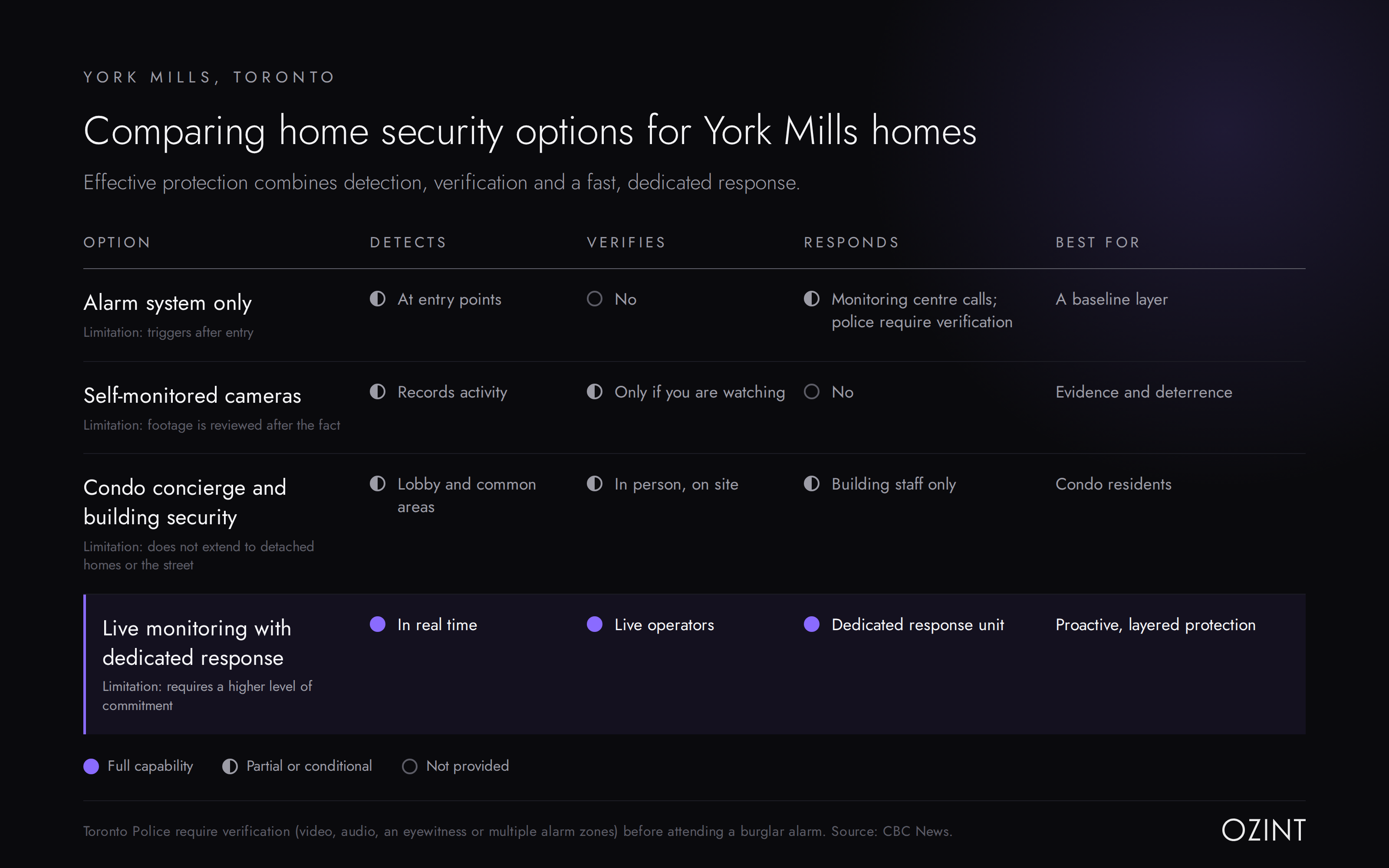
Verification matters more than most homeowners realize. Since 2018, Toronto Police have required evidence of a crime, such as video, audio, an eyewitness or multiple alarm zones, before attending a burglar alarm. The change followed an internal review that found 97% of home alarm activations in 2016 were false (CBC News).
For a deeper comparison, read Alarm Monitoring vs. Live Patrol in Toronto and Home Security vs. Mobile Patrol for Your Toronto Home.
Toronto Police have made real progress. In 2025, the average response time to Priority 1 emergency calls fell 17.5% to 14.1 minutes, according to the Chief's 2025 Annual Report. That improvement reflects the Service's multi-year hiring plan to rebuild frontline capacity.
Even so, the gap is structural. An organized group that plans to be in and out within minutes can complete a break-in before any city-wide service can reasonably arrive. That is not a failure of police; it is the reason homeowners add private, local layers.
Proactive security focuses on the minutes before and during an incident, rather than the report afterwards. Learn more in Proactive vs. Reactive Home Security and The Anatomy of 90 Seconds.
Recent break-ins in Toronto's finest neighbourhoods have often started at the front door. Reinforced strike plates, longer hinge screws, a solid-core door and laminated or impact-resistant glass beside the entry all add time and noise to a forced entry.
Store jewellery in a bolted safe away from the primary bedroom. Keep vehicle keys and keyless fobs away from the front entry, ideally in a signal-blocking pouch.
Many York Mills homes back onto ravines or mature trees, which give privacy but limit visibility. Motion lighting, camera coverage of rear yards and side paths, and secure patio doors close the approaches that front-facing systems miss.
Use lighting schedules, pause deliveries and arrange live monitoring while you are away. Winter travel and summer cottage season are common windows of vulnerability.
An alarm tells you something happened. Live monitoring with a dedicated local response is designed to intervene while it is happening.
For more, see the most common security mistakes high-end homeowners make.
Yes, for violent crime. None of the three police neighbourhoods covering York Mills recorded a homicide in 2025. Property crime is the main concern: two of them ranked among Toronto's top 10 for break and enter rates in 2025, according to Toronto Police Service data.
York Mills is split between three official Toronto Police Service neighbourhoods: St.Andrew-Windfields north of York Mills Road and east of Yonge, Bridle Path-Sunnybrook-York Mills south of York Mills Road and east of Yonge, and Bedford Park-Nortown west of Yonge.
No. In 2025, break and enters fell 28% in St.Andrew-Windfields, 35% in Bridle Path-Sunnybrook-York Mills and 36% in Bedford Park-Nortown. Rates east of Yonge remain about twice the Toronto average.
Auto theft has fallen sharply. St.Andrew-Windfields recorded 137 auto thefts in 2023 and 38 in 2025, and all three York Mills neighbourhoods now have auto theft rates below the Toronto average.
In 2025, the Toronto Police Service's average response time to Priority 1 emergency calls was 14.1 minutes, down 17.5% from 2024, according to the Chief's 2025 Annual Report. Actual response times vary by call volume, location and time of day.
Toronto Police require verification before attending a burglar alarm, such as video or audio evidence, an eyewitness or multiple alarm zones triggering. The policy was introduced in 2018 after a review found 97% of home alarm activations were false. Panic and duress alarms still receive a response.
Look for live, verified monitoring, a defined local response time, the training background of personnel, and how the provider coordinates with police. Our guide to questions to ask a Toronto security company covers each in detail.
OZINT Security Group is a Toronto-based private security firm founded by veterans of elite Israeli security and intelligence units. Our operators are drawn from elite military, governmental and intelligence backgrounds, and every operator completes continuous, scenario-based training to the same standard used to protect heads of state. In an industry with no formal training minimums, we set our own.
OZINT provides residential and estate protection, executive and close protection, corporate security, event security, secure transportation, and investigations and intelligence for families, executives and organizations across the GTA.
Overwatch™ is OZINT's zone-based residential protection program. Instead of reacting after an alarm sounds, it combines three integrated layers that work together every night:
The difference is timing. Reactive systems document what happened. A proactive system is designed to detect, verify and respond while there is still time to change the outcome.
Learn more about Overwatch™ in York Mills, explore the Overwatch™ program, or book a private security consultation with our team.


