Comparing monitored alarm systems and mobile patrol security for Toronto homes - how each works, when each makes sense, and why many of the city's finest neighbourhoods use both.
July 27, 2026
Homeowners across Toronto are paying closer attention to how they protect their property. Rising concern about break-ins, driveway theft, and home invasions in the city's finest neighbourhoods has pushed families to look past a basic alarm sticker in the window.
Two options come up most often: a monitored home security system and mobile patrol security. Both offer real protection, but the right fit depends on the property, the neighbourhood, and what a homeowner actually expects to happen in the moment something goes wrong. This guide breaks down what each option does, where each falls short, and how to decide.
Quick answer: A security system detects and alerts. Mobile patrol physically responds. Toronto Police have not dispatched to unverified alarms since 2018, which means a system alone often can't guarantee anyone shows up quickly. For most homes in premium Toronto neighbourhoods, the strongest setup combines monitoring with a physical, on-the-ground response.
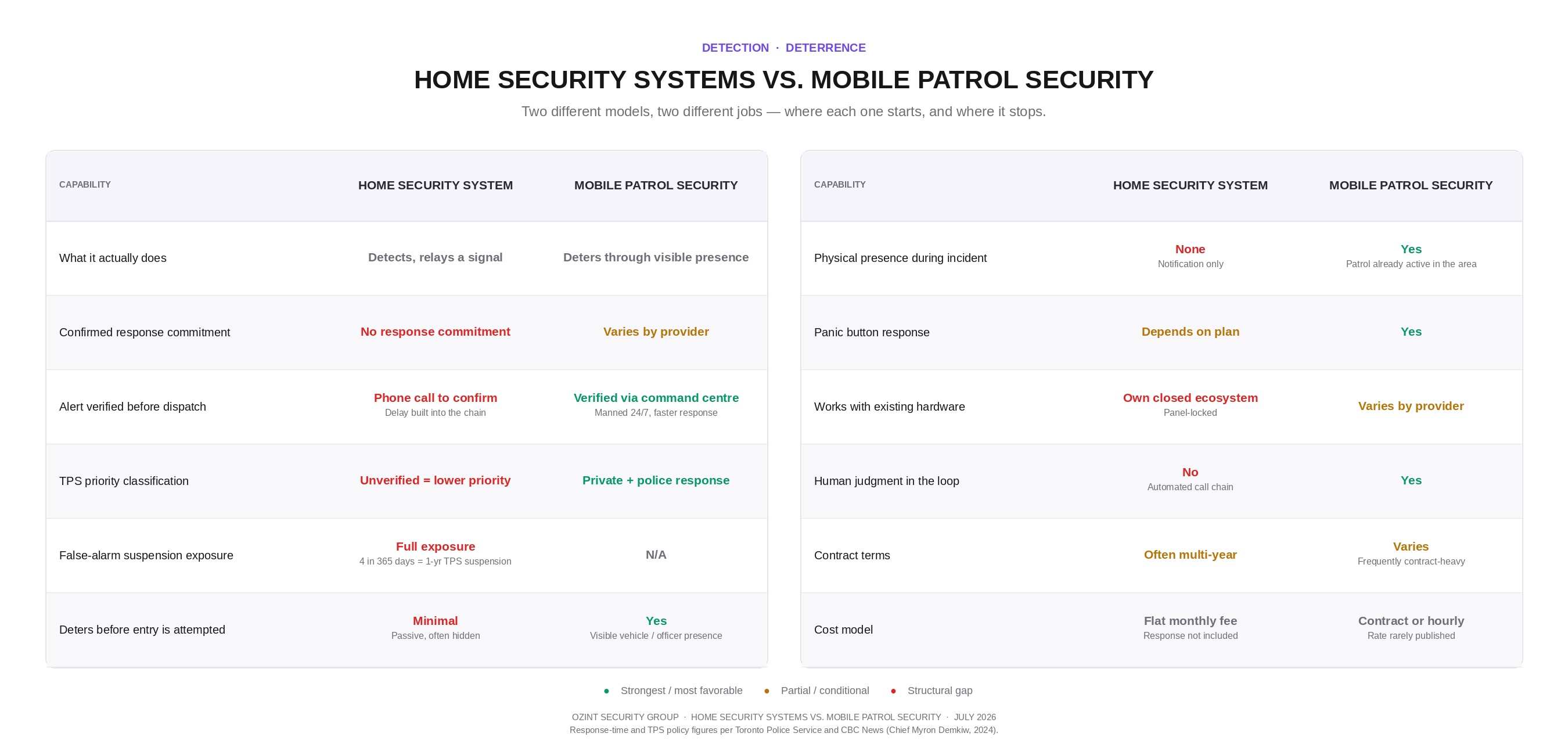
Residential protection today generally falls into two categories. A security system is technology-driven: sensors, cameras, and a monitoring centre that watches for trouble and sends an alert. Mobile patrol security is people-driven: trained personnel who move through a neighbourhood or property on a schedule, watching for anything out of place and stepping in when something is.
The distinction matters more in Toronto than in most cities. Since September 2018, Toronto Police Service prioritizes dispatch to residential alarm activations when there is verified evidence of a break-in, such as video, audio, or an eyewitness. A triggered siren by itself does not bring a car to your door. That single policy shift is a big part of why homeowners in Forest Hill, Rosedale, Lawrence Park, Summerhill, and the Bridle Path have started asking a different question: not just "do I have a system," but "does anyone actually come."
A modern system gives a home continuous, low-effort coverage. Door and window sensors, motion detectors, and cameras feed into a monitoring centre that reviews activity around the clock. When something trips the system, the centre assesses the alert and decides whether to contact the homeowner, dispatch a response, or notify emergency services.
Systems also work as a deterrent on their own. A visible camera or a control panel near the front door is often enough to send an opportunistic intruder toward an easier target. That's a genuine benefit, and it's part of why systems remain the entry point for most homeowners, especially those who travel often or spend long hours away from the property.
The limitation is structural, not a flaw in any particular product. A system can tell you, with real precision, that something is happening. It cannot do anything about it. Someone still has to arrive, and in Toronto, an unverified alarm is treated as low priority. Roughly 97% of alarm activations turn out to be false, which is exactly why police have moved to a verification-first model rather than dispatching to every trigger.
Larger properties, long driveways, and streets with recent incidents benefit most from the added physical presence. Mobile patrol adds something no camera can replicate: a trained person, physically present, making real-time judgment calls. Patrol teams complete scheduled or randomized checks across a property or a neighbourhood, watching for unusual behaviour, confirming entry points are secure, and responding immediately when something looks wrong.
The presence itself is a deterrent. A patrol vehicle moving through a street signals, in a way a doorbell camera cannot, that someone is actively watching. Trained personnel can also do what a sensor can't: check a dark corner of a property, assess whether a situation is serious, and engage before it escalates rather than simply recording that it happened.
For homes on larger lots, homes with long driveways or limited sightlines, or streets that have seen a recent rise in break-ins, that physical buffer matters. Visibility discourages opportunistic activity, and a fast, in-person response can be the difference between an attempted break-in and a completed one.
The right choice depends on the property and the neighbourhood around it. A system tends to work well where foot traffic is steady, neighbours are attentive, and emergency response is genuinely fast. For a home in a dense, well-trafficked pocket of the city, a solid monitored system paired with attentive neighbours can cover a meaningful share of the risk.
Patrol tends to matter more where a system's blind spots are largest: bigger lots, long driveways, tree cover that blocks sightlines, or a street that has already seen an uptick in activity.
That last point is not hypothetical in Toronto. A decade-long analysis of Toronto Police data found that while citywide break-and-enters fell 27% between 2015 and 2025, several of the city's finest neighbourhoods moved sharply the other way: Rosedale-Moore Park rose 145%, Yonge-St. Clair rose 236%, and Mount Pleasant East rose 233%. The city got safer on average. Homes in that bracket often experienced the opposite.
Response time is the other half of the equation. Toronto's own Police Chief has confirmed that average Priority 1 emergency response, the category reserved for the most urgent calls, now runs around 22 minutes, and that in roughly 60% of those calls, no unit is immediately available to attend at all. That's not a criticism of policing; it's a resourcing reality homeowners can plan around. For a property where a fast, physical response actually matters, it's a strong argument for a presence that's already close by.
Layered protection is becoming the norm rather than the exception in Toronto's premium neighbourhoods. When a system and a patrol presence work together, detection and response stop being two separate problems. A triggered sensor or camera alert can be verified in person almost immediately, rather than sitting in a queue as one more unconfirmed call. That verification is also what gets a homeowner past the 97%-false-alarm problem: a team that can visually confirm a real threat isn't competing with every other unverified trigger in the city for police attention.
This is the exact gap OZINT built Overwatch to close. Rather than treating monitoring and physical response as two separate purchases, Overwatch combines live AI-supported monitoring, a dedicated response unit already positioned within the zone, and a 24/7 command centre into a single system. When an alert is verified, an operator isn't dispatched from across the city, they're already close, with a response target of 90 seconds. It's the same layered logic homeowners are already reaching for on their own, built in from the start instead of assembled after the fact.
The right setup comes down to the property and what the homeowner actually expects to happen if something is triggered. Worth weighing before deciding:
An honest security assessment, one that actually walks the property rather than quoting a package over the phone, is the fastest way to see which factors apply to a specific home.
A patrol presence benefits more than one address. Visibility on a street tends to raise the cost of attempting anything on that street at all, which is part of why patrol has grown in popularity across Forest Hill, Rosedale, Lawrence Park, and similar communities, not as a replacement for a system, but as the piece that was missing.
The timing lines up with what Toronto's crime data has actually been showing. Home invasions reached a 10-year high in 2024, with 231 victims across 149 incidents, and the trend continued into 2025 and 2026. At the same time, vehicle theft has fallen from its 2023 peak, which several police services attribute in part to organized crews shifting method rather than stopping altogether, moving from stealing cars off driveways toward targeting homes directly. A patrol team already positioned nearby, rather than dispatched from across the city, is often the fastest physical response a household can realistically expect.
What's the difference between a home security system and mobile patrol security in Toronto?
A security system detects activity through sensors and cameras and alerts a monitoring centre. Mobile patrol puts trained personnel physically on the ground to check the property, verify a threat, and respond in person. One watches; the other shows up.
Does Toronto Police actually respond when my alarm goes off?
Not automatically. Since September 2018, Toronto Police Service has only dispatched to residential alarms with verified evidence of a break-in, such as video, audio, or an eyewitness. Roughly 97% of alarm activations turn out to be false, which is why unverified triggers are deprioritized. Panic button activations are treated differently and are exempt from the standard verification requirement.
Is mobile patrol worth it if I already have cameras and an alarm?
For many homeowners, yes. A system tells you something is happening; patrol is what actually responds to it. Pairing the two means an alert can be verified in person quickly rather than waiting on a police response that, in Toronto, currently averages around 22 minutes for the most urgent calls, with no unit available at all roughly 60% of the time.
Which Toronto neighbourhoods benefit most from mobile patrol?
Larger-lot, lower-density neighbourhoods tend to benefit most, including Forest Hill, Rosedale, Lawrence Park, Summerhill, and the Bridle Path. These are also among the areas where Toronto Police data show break-ins rising over the past decade even as the citywide rate declined, which is part of why patrol demand has grown there specifically.
How fast can a security response actually reach my home?
It depends entirely on the model. A distant call centre calling police means waiting on an average Priority 1 response of around 22 minutes, assuming a unit is available at all. A dedicated local ground unit changes that math. OZINT's Overwatch, for example, holds a response unit within the zone it serves, targeting a 90-second response once a threat is verified.
Can I combine a security system with patrol services instead of choosing one?
Yes, and for most homes in Toronto's premium neighbourhoods, that combination is the strongest setup available. Detection and physical response solve different halves of the problem, and pairing them removes the single point of failure that comes with relying on either one alone.


