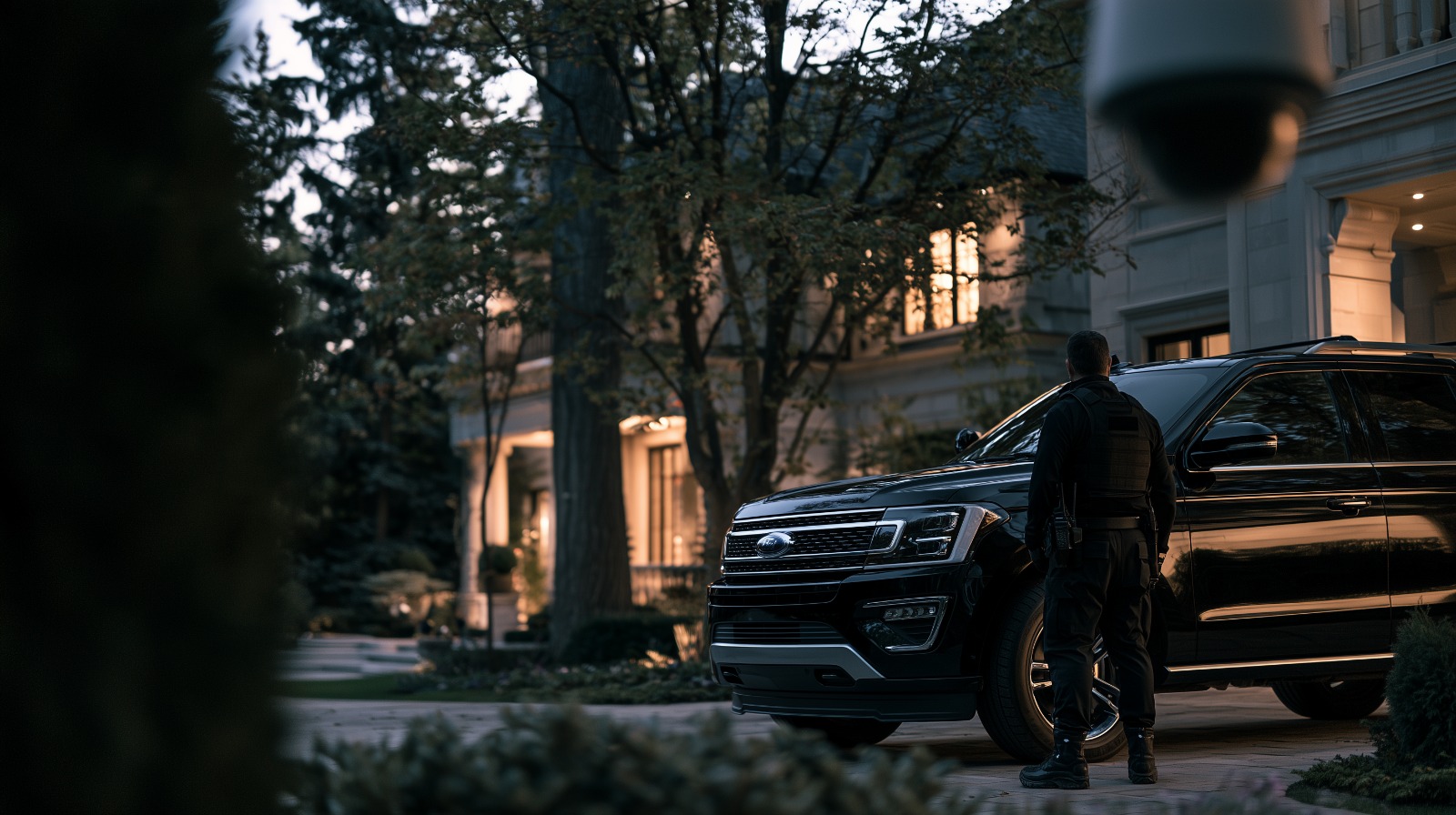
Why reactive home security, and most private security in Toronto, was built to notify, not respond. The proactive vs. reactive data every Toronto homeowner should see.
September 16, 2026
Reactive home security, an alarm that calls a monitoring centre, a camera that records footage, was built to notify someone after a break-in starts, not to stop one in progress. In Toronto, the average emergency response now takes 14 minutes, while a typical break-in is over in 8 to 12 minutes. Most private security in Toronto still runs on that same reactive model, just privatized. Proactive security closes the gap instead of privatizing it, detecting and intervening before the moment a homeowner needs help most.
Most Toronto home security is still sold, and bought, on the same basic promise it has offered for thirty years: install an alarm, add a few cameras, and you're protected. It's an easy pitch to believe. The panel arms when you leave. The app shows a green checkmark. For a long time, that was a reasonable standard. It is no longer one.
The gap isn't in the technology. Alarms trigger reliably. Cameras record clearly. The gap is in what homeowners assume that technology is doing for them. A monitored alarm's actual job is to detect an event and notify someone, a call centre, a homeowner's phone, eventually a dispatcher, that something happened. It was never engineered to intervene while it's happening.
In Toronto specifically, that distinction carries real weight, because roughly 97% of alarm activations turn out to be false (Toronto Police Service, Understanding Alarm Response). Confirmed threats have to be prioritized over that volume, a reasonable policy from a police service's perspective, and a genuine problem from a homeowner's perspective if the alarm is the entire plan.
This is the misconception at the centre of this piece: reactive security was sold, and largely still is, as sufficient on its own. For a Toronto home in 2026, sufficient means something different than it did a decade ago.
Strip away the marketing language and the difference comes down to one question: does the system stop at telling you, or does it act?
Detect. Notify. Wait. That's reactive. A sensor trips, a signal is sent, someone eventually finds out. It's a documentation system. It tells you what happened, useful for insurance claims and police reports, and far less useful in the minutes the incident is actually unfolding.
Detect. Verify. Respond. That's proactive. Presence and monitoring exist specifically so an incident doesn't get the chance to complete. A camera gives you footage of a break-in after it happened. Proactive security is built so the break-in doesn't finish in the first place.
Neither approach is a flaw in engineering. Alarms and cameras do exactly what they were designed to do. The problem is assuming detection and response are the same category of protection. They're two different jobs, and most Toronto homes, and most private security companies serving them, only have the first one covered.
This is where the misconception runs into arithmetic, and the arithmetic doesn't favour a reactive-only homeowner.
Toronto's own Police Chief, Myron Demkiw, reported that average Priority 1 emergency response fell 17.5% year-over-year to 14.1 minutes (Toronto Police Service, Chief's Annual Report, August 2026; data.tps.ca). That's real improvement, part of the first year of the Service's Multi-Year Hiring Plan to rebuild frontline capacity. It doesn't close the gap this section is about, though. A typical residential break-in is still over in 8 to 12 minutes, several minutes before an average Priority 1 response arrives. The math is tighter than it used to be. It isn't resolved.
There's a second layer most Toronto homeowners don't know about. Under current Toronto Police Service policy, homes that accumulate four false alarms within 365 days can have police response to that address suspended for a full year. Panic alarm activations are the one exception, exempt from standard verification and dispatched immediately. It's one of the few levers a homeowner actually controls directly, and most reactive systems aren't built around it.
Key takeaway: Toronto's 14-minute average response and the 8-to-12-minute break-in window overlap almost entirely. For a large share of break-ins, the response arrives after the event, not during it.
Everything above describes a gap in minutes. This section is about what that gap means once someone is standing in a hallway that isn't theirs.
Once an intruder is already inside a Toronto home, response speed stops being the relevant variable. The moment security was supposed to work was earlier, in detection and prevention, not in how quickly someone can be dispatched after the fact.
"The fastest response in the world doesn't change the fact that someone was already inside. When everything is built around reacting, responding after the fact is irrelevant, because the crime is already in progress." — Zohar Haimov, Founder & CEO, OZINT Security Group
That's the case for proactive security in one line. It isn't an argument against alarms or cameras, both remain genuinely useful. It's an argument against treating detection as if it were the whole job. We don't just react. We anticipate. A home protected only by reactive tools is protected right up until the moment it matters most, and unprotected exactly then.
The proactive vs. reactive gap isn't evenly distributed across Toronto, and that matters for how homeowners in specific neighbourhoods should read the data.
Toronto's citywide numbers, on their own, are genuinely good news. A decade-long analysis of Toronto Police Service data found citywide break-and-enters fell 27% between 2015 and 2025 (Globe and Mail, 2026). But Toronto's own Neighbourhood Crime Rate data shows several of the city's highest-value pockets moving sharply the opposite direction:
Forest Hill and Lawrence Park share a Toronto Police division, 53 Division, with Yonge-St. Clair and Rosedale-Moore Park, two of the fastest-rising break-in areas in the city. Shared coverage means a homeowner's actual protection depends on more than their own street. Toronto logged 231 home invasion victims across 149 incidents in 2024, a ten-year high, with 2026 figures trending upward again (CBC News, 2026).
Key takeaway: A citywide average is the wrong lens for a homeowner in Forest Hill, Rosedale, Bridle Path, Lawrence Park, or Summerhill. The relevant comparison is neighbourhood-level, and in these specific pockets, the trend points toward more exposure, not less.
A fair account of this topic has to include where reactive tools genuinely work, because they do, for a specific kind of offender.
A widely cited University of North Carolina at Charlotte study surveyed 422 convicted burglars across three U.S. states about how they choose and abandon targets. 83% said they'd try to determine whether an alarm was present before attempting a burglary, and 60% said they'd move to a different target if they found one (Kuhns et al., 2012, via ScienceDaily). Visible cameras carry a roughly 53% deterrent effect, close to double a security sign alone (Security.org). On those numbers, detection technology does exactly what it's supposed to: it changes which house gets picked.
Expert insight: the nuance that matters for Toronto's highest-value neighbourhoods is what that 83% and 60% actually describe, an offender comparing several possible homes and choosing the easiest one. Toronto Police and CBC reporting have tied the city's recent rise in home invasions to a different offender profile: organized crews that select a specific property in advance, often for a specific vehicle or set of keys, through reconnaissance rather than opportunity. For that offender, an alarm's function shifts from deterrent to notification.
That pattern deepened in May 2026, when York Regional Police formally identified a new attacker class operating across the GTA: organized groups who enter Canada legally as tourists, run a short, coordinated operational window of residential break-ins, then leave before domestic intelligence can catalogue them. It's a useful case study in why reactive systems, including reactive policing itself, are structurally limited against this kind of threat. There's no local recruitment trail to interdict, so the public warning arrives only after the operational window has already closed.
The indicators, short-term rental clusters used as staging, unfamiliar vehicles surveying the same block across several evenings, are visible to a trained analyst well before a break-in happens. They're invisible to a homeowner, and to any system that only starts working once a sensor trips.
None of this is a criticism of alarms and cameras, or of policing. It's a clarification of what reactive systems, public or private, are actually built to do, so a Toronto homeowner can evaluate honestly whether their current setup covers detection only, or detection and response together.
Once the reactive gap is visible, the shape of a proactive answer becomes fairly intuitive: close the distance between detection and response, so the two happen as close to simultaneously as possible.
Most private security in Toronto, alarm-monitoring firms and traditional guard companies alike, still runs on two layers: detection, then response. OZINT built Overwatch™ around three.
Technology: AI-enabled detection and panic buttons wired directly into a live Security Operations Centre, no third-party relay in between.
Command Centre: real human oversight verifying every alert visually before anyone is dispatched, the layer most of the industry skips, and the one that turns a fast response into a real one.
Ground Force & Patrols: a dedicated response unit stationed continuously inside a defined zone, already close because it never left.
The result is a target of 0 to 90 seconds from a verified alert to operators on scene, against the 14-minute citywide average described earlier. Coverage runs at roughly one operator per 30 to 50 homes, and each zone is capped at that density, then closed. Most of the industry expands coverage as client volume grows, one of the more common reasons response times quietly slip over time. Overwatch™ zones are already active in Forest Hill, Rosedale, and Summerhill, with expansion following the same neighbourhood-first model.
Personnel matter as much as architecture. Ontario's Private Security and Investigative Services Act sets a training standard and stops there, nothing required beyond day one. Overwatch™ operators, many with military, law enforcement, or close protection backgrounds, train continuously, on a scenario basis, well past that minimum.
Before comparing providers or programs, it's worth answering these questions honestly about whatever is protecting your home right now.
If more than one of those answers is uncomfortable, the setup in place is very likely reactive, whatever it's marketed as.
Reactive security detects an incident and notifies someone after it happens. Proactive security is designed to detect and intervene before or during the incident, closing the gap between "something happened" and "someone responded."
A standard alarm's job is verification and notification, not physical intervention. By the time a signal is confirmed and police are dispatched, Toronto's average response takes 14 minutes, while most break-ins are over in 8 to 12 minutes.
Toronto's Police Chief has publicly confirmed average Priority 1 response now takes 14 minutes, with no unit immediately available 60% of the time (CBC News, 2024).
Toronto Police Neighbourhood Crime Rate data puts Rosedale-Moore Park at roughly 456 break-ins per 100,000 residents, Bridle Path/Sunnybrook/York Mills at roughly 403, and St. Andrew-Windfields at roughly 385, all well above the citywide rate. Forest Hill, Lawrence Park, and Yonge-St. Clair have also moved sharply upward over the past decade.
It's a pattern York Regional Police formally identified in May 2026: organized groups entering Canada legally as tourists to run a short, coordinated window of residential break-ins before leaving. Because there's no domestic recruitment trail, standard reactive policing intelligence tends to catch the pattern only after it's already occurred in a given area.
Yes, for a specific type of offender. Convicted burglars surveyed by UNC Charlotte said a visible alarm changes their target selection 60% of the time. That effect is strongest against someone still comparing several houses, weaker against an organized crew that has already selected a specific property in advance.
It depends on what's being protected and where. In the neighbourhoods described above, the gap between a phone notification and a dedicated response unit already inside the zone is the entire value proposition. For lower-risk situations, a verified monitored alarm may be enough.
A layered system: AI-enabled detection, a live Command Centre that verifies every alert, and a dedicated patrol unit already stationed inside a defined zone, typically responding within 90 seconds.
Reactive home security isn't broken. It's doing exactly the job it was built to do, thirty years ago, when that job was considered enough. The misconception isn't that alarms and cameras don't work. It's assuming that detection and protection are the same thing, when for a Toronto homeowner today, they aren't, and most private security in this city still hasn't closed that gap.
Overwatch™ was built to close it: Technology, Command Centre, and Ground Force, operating as one system, so response happens in seconds instead of minutes. Learn more about Overwatch™.
Zohar Haimov is walking through this exact topic, live, in OZINT's upcoming webinar, Reactive vs. Proactive Residential Security, on Thursday, September 17th at 7:00 PM EST. Register for the webinar.


