
Learn how AI-enabled CCTV cameras, OZINT's AI analytics and live CCTV monitoring can protect Toronto homes, plus where to place each camera for effective property coverage.
October 9, 2026
Most homes in Toronto's top neighbourhoods already have cameras. Yet many homeowners still learn about a break-in or potential intrusion the same way: a phone notification, a short video clip, and a terrible feeling of uncertainty. The camera did its job. It recorded—but that’s all it did. The camera did its job. It recorded - but that’s all it did.
Indoor and outdoor cameras alone are simply not enough. Here at OZINT Security Group, we believe home security cameras need to be professional-grade, monitored with a human in the loop, and part of a multi-layered system. Without that backing, they are not a deterrent; they're just a digital witness.
Modern AI has fundamentally changed what a camera can do. Today’s pro-grade systems actively monitor 24/7, day or night, in any weather conditions. Instead of filming everything and waiting for someone to review it later, an AI-enabled CCTV system recognizes a person, object, or vehicle in real time, decides whether it matters, and triggers a response while the event is still unfolding. Paired with live CCTV monitoring, the camera stops being a passive witness and becomes your critical first layer of protection.
In this article, we explain how OZINT security cameras use their AI analytics operates in real time, how they connect to a multi-layer system, what separates professional CCTV from store-bought cameras, and exactly where to place them on a Toronto property so they do much more than just record.
The typical store-bought camera does three things: it records, it sends a notification to your phone, and it waits for you. That model has two weaknesses.
The first is alert fatigue. Basic motion detection reacts to changing pixels, so headlights, swaying branches, snowfall, and the neighbour's cat all trigger the same alert. After a few weeks of false notifications, most people mute them. The alert that matters arrives buried among dozens that don't. The second is that nobody else is watching. The homeowner is the monitoring centre, whether they are asleep, in a meeting, or on a flight for vacation.
But there is a more significant third concern: when a crime is in progress, most camera systems are not connected to any human oversight to take action. Even if the system simply alerts Toronto Police Services, that built-in delay leaves your home unprotected during the exact window when a response matters most.
A traditional camera with motion detection compares one frame to the next and flags any change. However it has no idea what changed. A raccoon and a person look the same to it.
An AI-enabled security camera runs object recognition directly on the device, often called edge AI. When something moves in the frame, the AI compares it against a trained reference library of people and vehicles seen from many angles, and weighs its size, proportions, shape and movement. Only objects that match a person, car or two-wheeled vehicle are treated as events.
This happens in three stages: Detect, Distinguish, and Alert.
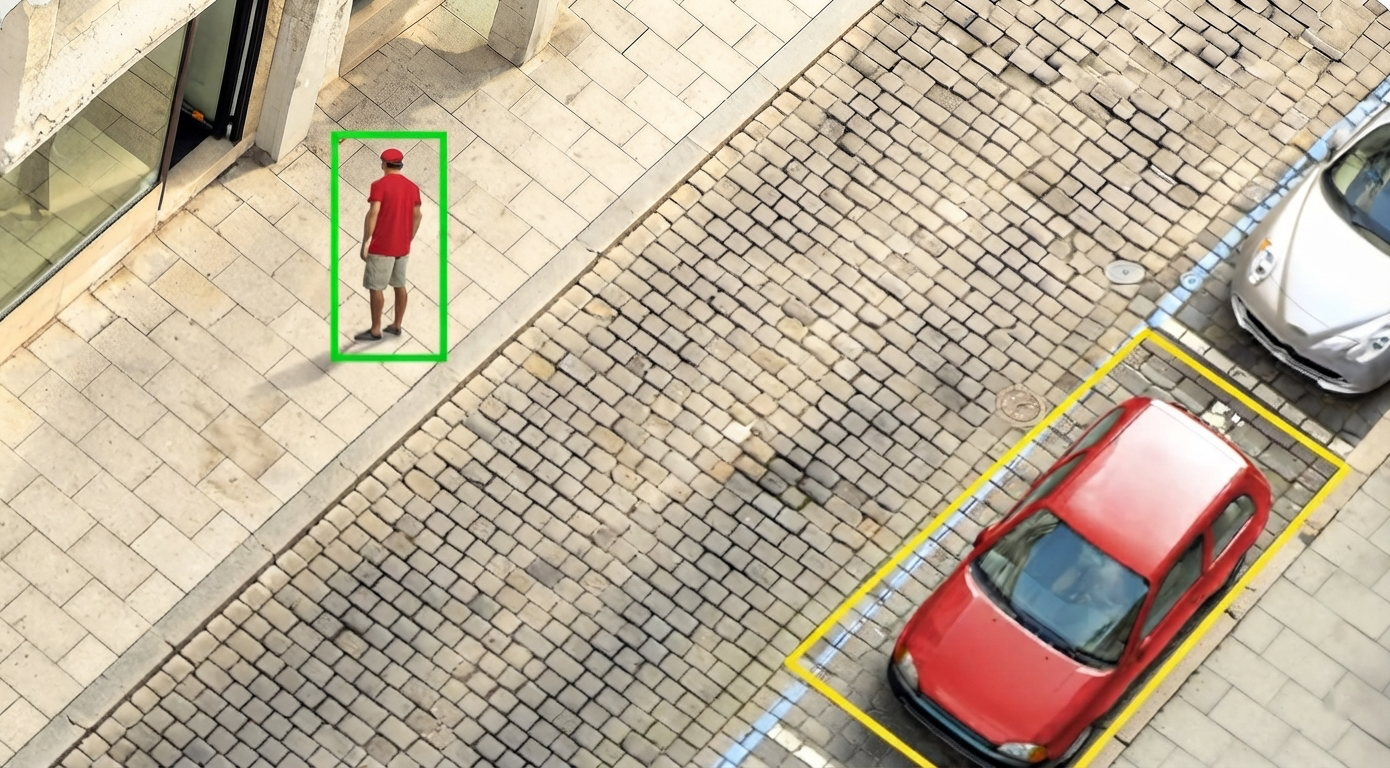
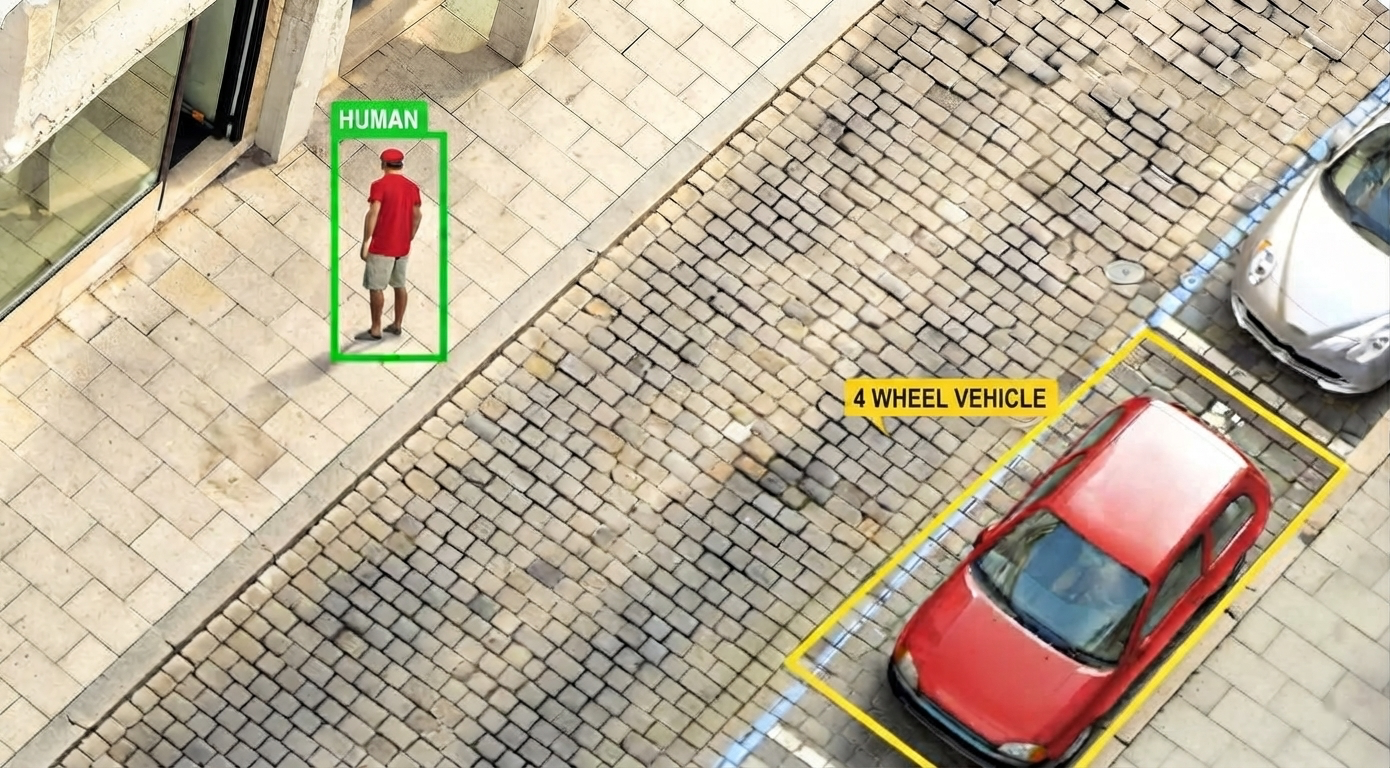
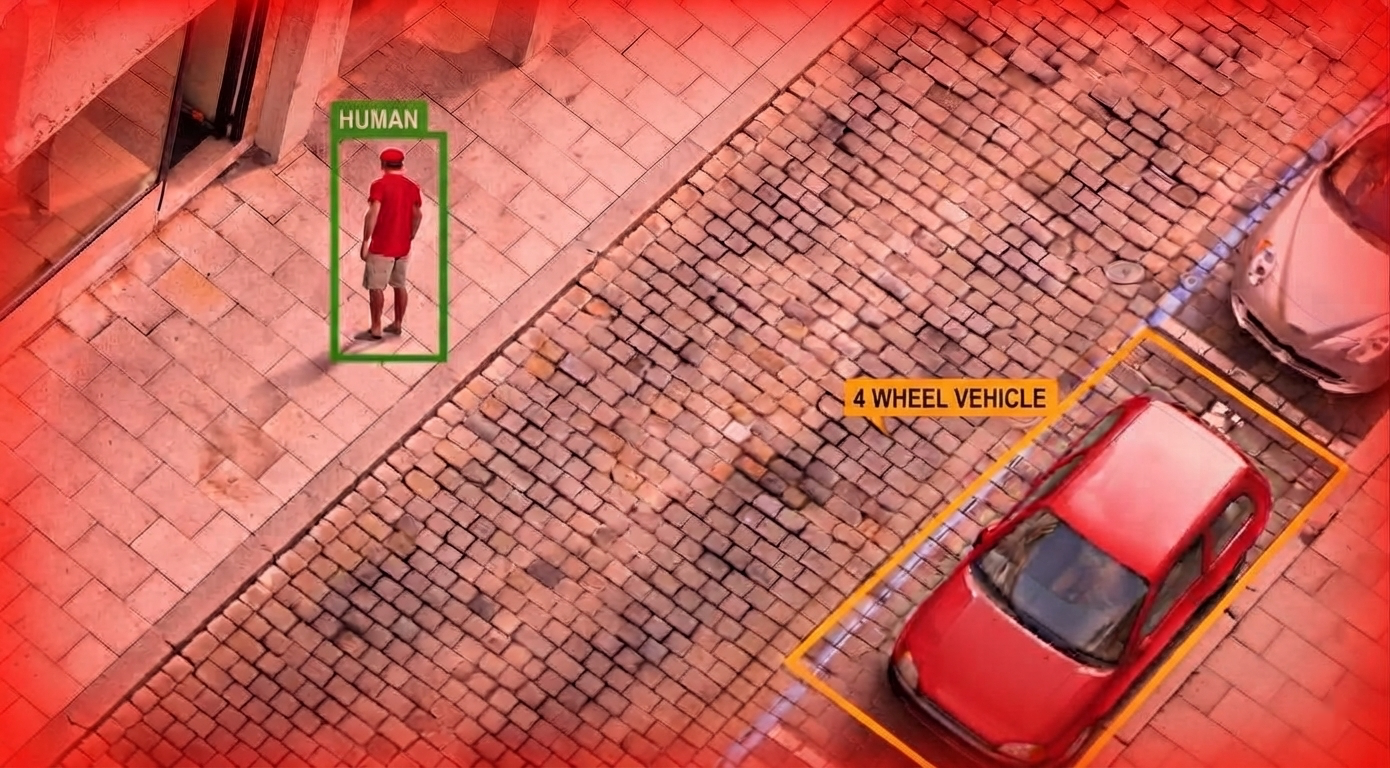
Because the analysis happens on the camera rather than in a distant cloud server, decisions are made in real time and the system keeps working even if your home internet is slow.
Original images from Pro-Vision.
Inside every OZINT professional CCTV security camera is a next-generation AI video analytics engine. It turns a high-resolution camera into an active security sensor that knows what to look for, where to look and when to take action - without thinking or waiting. They can trigger an alert to a human in the loop at the OZINT Command Centre that can instantly verify and trigger a panic system, or dispatch TPS and the our zone-based patrol units.
Below is a simple breakdown of how theCCTV’s AI analytics operates, and key highlights that allow CCTV to do more than just passively record.
A sterile area is a zone where no one should be at certain times. Think of the driveway after midnight, the pool deck in winter or the rear yard while you are travelling. When AI detects a person or vehicle inside that zone, it triggers an event instantly. Leaves blowing across the same area do not.
A tripwire is an invisible line drawn across a gate, a laneway or the edge of your property. Anyone who crosses it is flagged, day or night. Tripwires are especially useful on side gates, which are among the quietest approach routes on a detached Toronto home.
OZINT's cameras do more than watch. When an AI rule is broken, the camera can switch on a bright white light, flash red and blue strobes and play an audible warning through its built-in speaker. The goal is simple: make it clear the property is protected and turn someone away before they reach a door.
Most cameras switch to black-and-white infrared at night. OZINT cameras keep 30 m of infrared for general viewing, then turn on a 30 m white light when the AI detects a person. The image switches to full colour, so clothing, hair and vehicle colour are captured clearly. That detail can be decisive for an insurer or investigator.
The CCTV AI flags a camera that is covered, sprayed or knocked out of position. Each camera also carries an embedded Check Point security agent and NDAA-compliant hardware, which matters because internet-connected cameras are a known target. Canada's Centre for Cyber Security has warned that attackers regularly exploit security flaws in connected home devices
This is where our AI analytics differs from consumer-grade solutions. The AI does not just send you a push notification. It starts a sequence:
Megapixels are no longer the difference. Most cameras today record sharp daytime video. The real gaps are in how a system detects, who responds and how it holds up over years of Canadian weather.
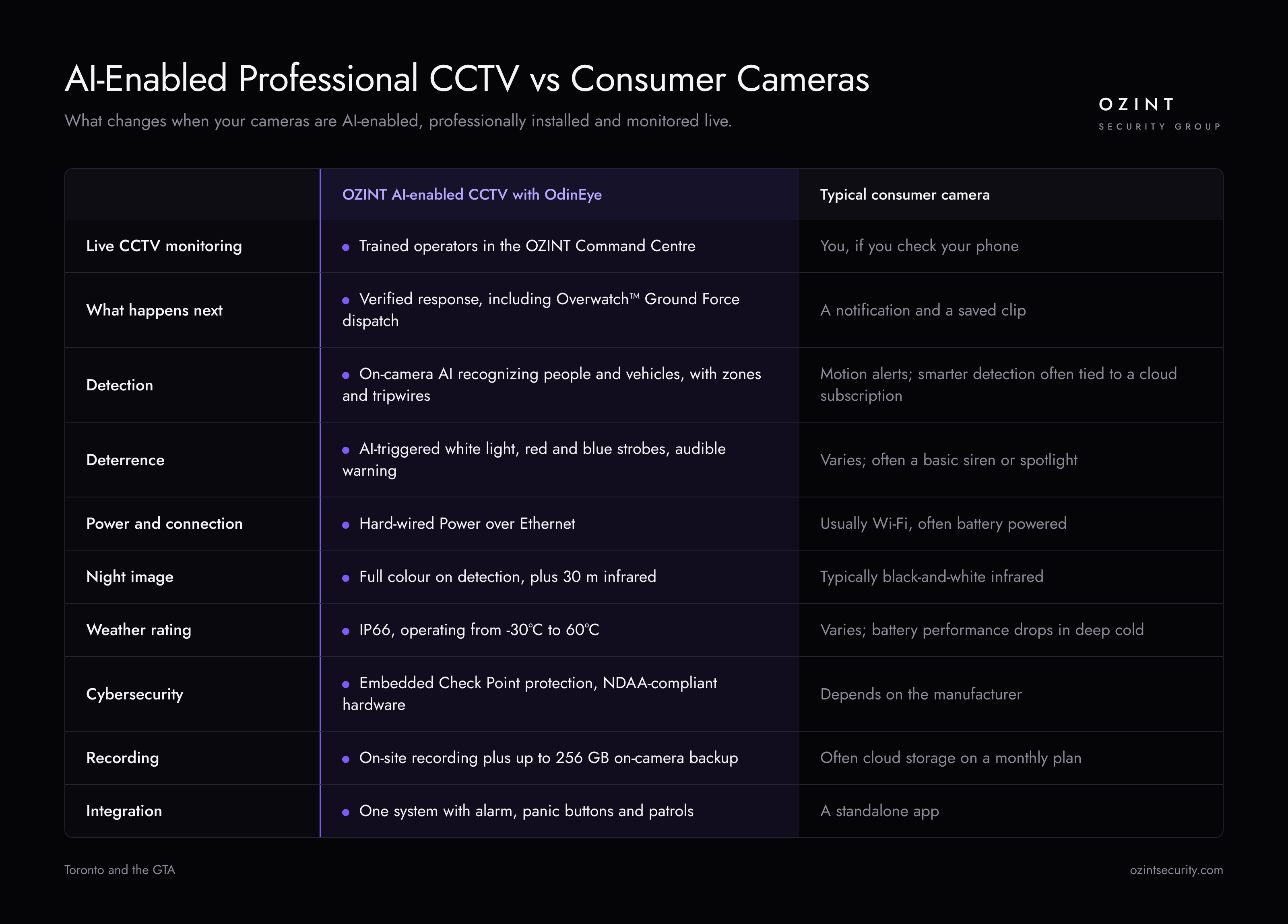
Two differences deserve a closer look. Hard-wired Power over Ethernet carries power and data through a single cable, so there are no batteries to recharge and no Wi-Fi signal for someone to jam or for a thick stone wall to block. And an IP66 rating with a -30°C operating range means a January cold snap is routine, not a reason for a camera to go offline.
AI is excellent at spotting activity. It never blinks, never gets bored and reacts in a fraction of a second. What it cannot do is understand context. Is that person a contractor who arrived early, a family member who forgot their keys or someone testing door handles?
That judgment belongs to people. With OZINT live CCTV monitoring, every AI event reaches a trained operator in the Command Centre, who sees the live feed, assesses the situation and decides what happens next. Monitoring can run overnight, during travel or 24/7.
"AI gives a camera reflexes. It spots a person at the edge of the property, ignores the noise and deters in seconds. What makes it security is what happens next: a trained operator verifying the threat and a response unit on the way before anyone reaches the door." - Zohar, Founder of OZINT Security Group
OZINT CCTV cameras, alarm sensors and panic buttons all report to the same Command Centre. That changes how each event is handled:
Individually, each device is useful. Connected, they become a coordinated security system. Learn how this works within Overwatch™.
Placement decides what a camera can prove. The international video surveillance standard IEC 62676-4 defines how much detail a camera captures at a given distance, often summarized as detection, recognition and identification.
For OZINT's core 4MP, 2.8 mm camera, those distances look like this:
In practice, a well-planned system uses a mix: wide cameras that detect early, and close cameras positioned where a person must pass within 6 m.
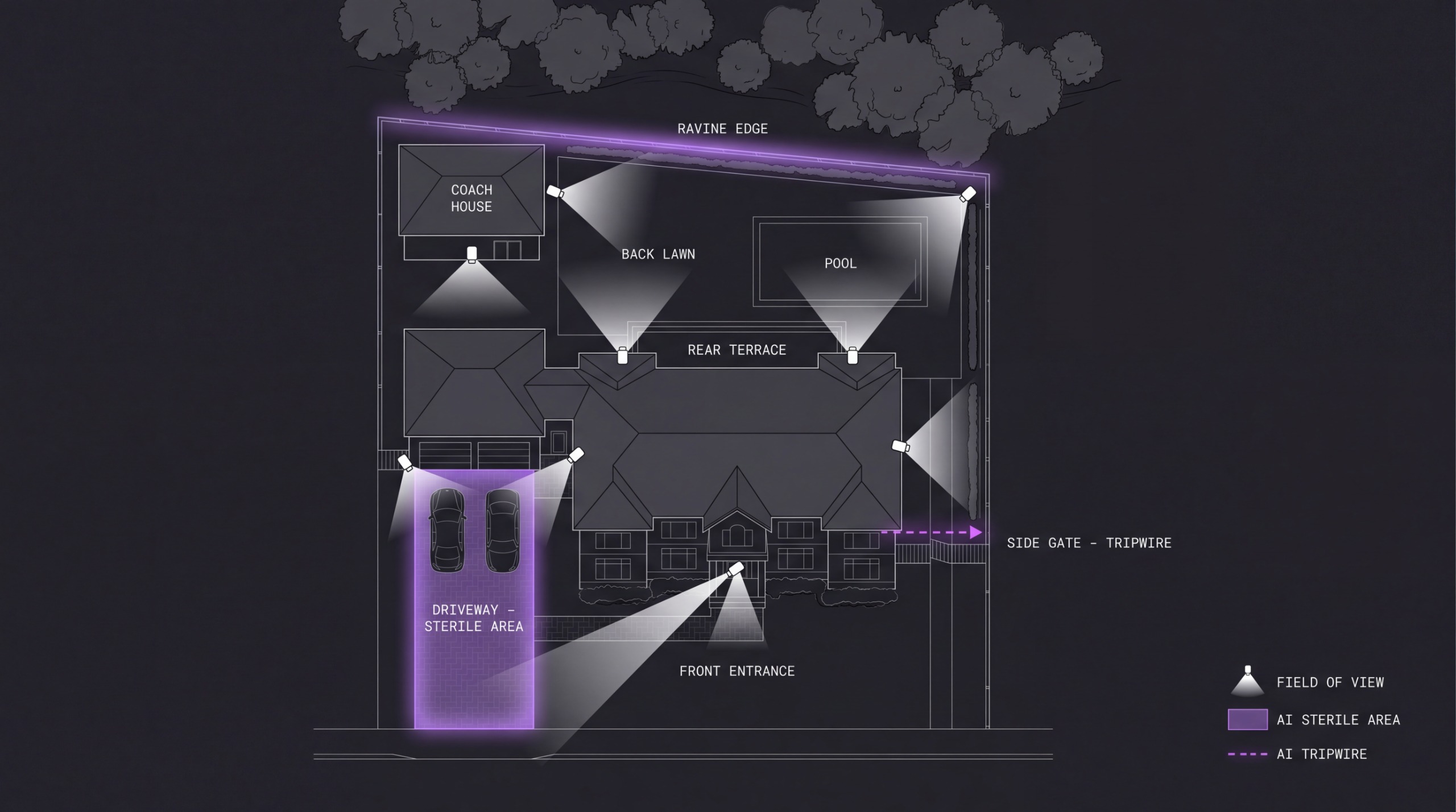
This is your identification camera. Mount it roughly 2.4 to 3 m high, within 6 m of where visitors stop, and angle it to see faces beneath hats and hoods. Front doors are often backlit, so true WDR (wide dynamic range) matters here. OZINT cameras use 120 dB true WDR to keep faces visible against bright daylight.
Set an AI sterile area across the driveway during overnight hours so any person approaching a vehicle triggers an event. Pair it with a recognition camera covering the vehicles themselves. Vehicle theft is a persistent concern across the GTA, which we cover in detail in our guide to protecting your driveway (internal link: Toronto driveway car theft post).
Side gates are quiet, shaded and out of view from the street, which makes them a common approach route. A virtual tripwire across the gate, combined with active deterrence, flags and confronts anyone who enters.
Many homes in Rosedale, the Bridle Path and Hoggs Hollow back onto ravines or open green space. Use AI sterile areas along the rear property line and the pool, where full-colour night imaging is especially valuable.
Coach houses, detached garages and pool houses often hold valuable vehicles and equipment but sit outside the main alarm envelope. A camera covering each entry point brings them into the same system.
Every OZINT camera system starts with a walk-through of your property. An OZINT specialist maps approach routes, blind spots, lighting, sightlines and privacy considerations, then designs an AI-enabled CCTV plan that places each camera for detection, recognition or identification.
AI zones and tripwires are defined for how your household actually lives, and the system is connected to your alarm, panic buttons and Command Centre monitoring. Once the one-time installation and hardware fee is paid, the equipment belongs to you.
Ready to see what your cameras could be doing? Book an AI CCTV assessment today.
For high-value homes, yes. DIY cameras record and notify you. AI-enabled professional CCTV recognizes real threats, deters intruders on the spot and connects to live CCTV monitoring, so a trained operator responds even when you can't.
The AI compares moving objects against a trained library of people and vehicles, weighing size, proportions, shape and movement. Animals, rain, shadows and moving branches are filtered out, which significantly reduces false alerts.
OZINT's AI video analytics engine runs on each OZINT CCTV camera, recognizes people and vehicles, applies sterile areas and tripwires, triggers active deterrence and sends verified events to the OZINT Command Centre.
An active deterrence camera responds to a detection with light and sound, such as a white light, red and blue strobes and an audible warning. It is designed to make an intruder leave before reaching the home.
Live CCTV monitoring means trained operators watch your camera feeds as events occur. At OZINT, operators in the Command Centre review AI alerts in real time, verify what is happening and coordinate the response, overnight or 24/7.
For identifying faces, roughly 2.4 to 3 m high and within about 6 m of where people stop. Wide-view cameras for early detection can sit higher and farther away.
Professional cameras do. OZINT CCTV cameras are IP66 rated and operate from -30°C to 60°C. Because they are hard-wired, there are no batteries to fail in the cold.
Any connected device can be targeted, which is why OZINT uses cameras with embedded Check Point protection and NDAA-compliant hardware, installed on a professionally configured network.
Homeowners can record their own property. Best practice is to keep cameras focused on your property, mask views of neighbouring yards and windows, and follow the City of Toronto's Good Neighbour Guide for residential security cameras.


