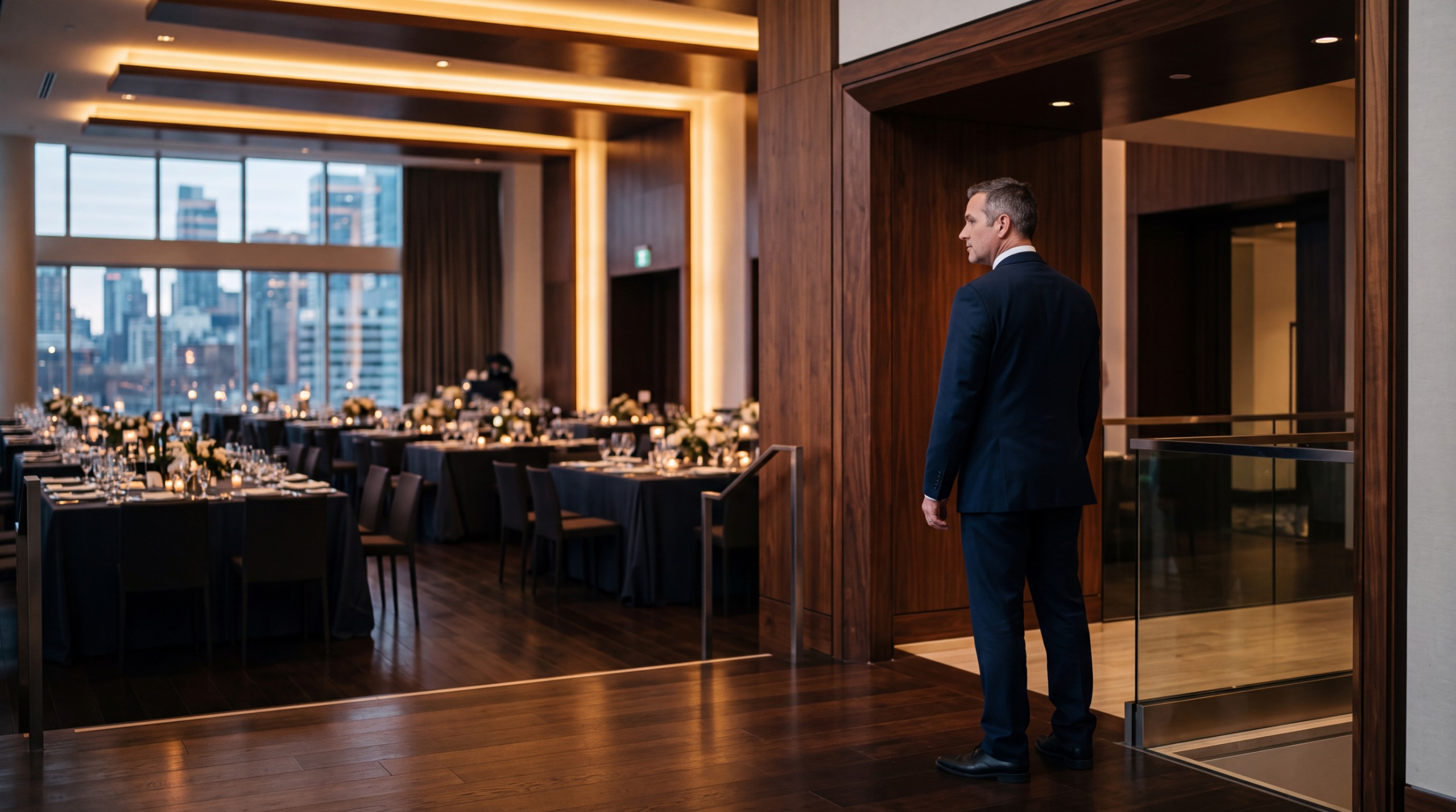
Need to secure your event in Toronto? Learn how OZINT event security is planned and practiced in Toronto, from the first conversation to the hour before doors and the debrief after. Any venue, any size, indoor or out.
October 6, 2026
By Zohar Haimov, Founder and CEO, OZINT Security Group. Last updated [date].
Event security in Toronto runs on six stages: risk assessment, crowd control and management, access control and VIP protection, event surveillance and monitoring, emergency response and incident management, and a post-event debrief. Personnel, screening equipment and K9 support are layered on according to what the assessment finds. Most of what decides the outcome happens before a single guest arrives.
The market standard is personnel booked for a date. Someone stands at a door, something either happens or it does not, and nobody learns anything afterward. Nothing was assessed, nothing was designed for that specific room, and the client finishes the night with no record of it.
A preventive model works differently. It begins with a conversation about what the event actually is, continues with a plan built for that venue and that guest profile, and places people and equipment where risk genuinely sits rather than where it is conventional to stand. On the night, the team executes a plan instead of improvising around one.
The aim is a quiet evening. When an event finishes and the host's strongest memory of security is that they stopped thinking about it, that is not an absence of work. That is the work.
The category sets the shape of the plan. The assessment sets its scale.
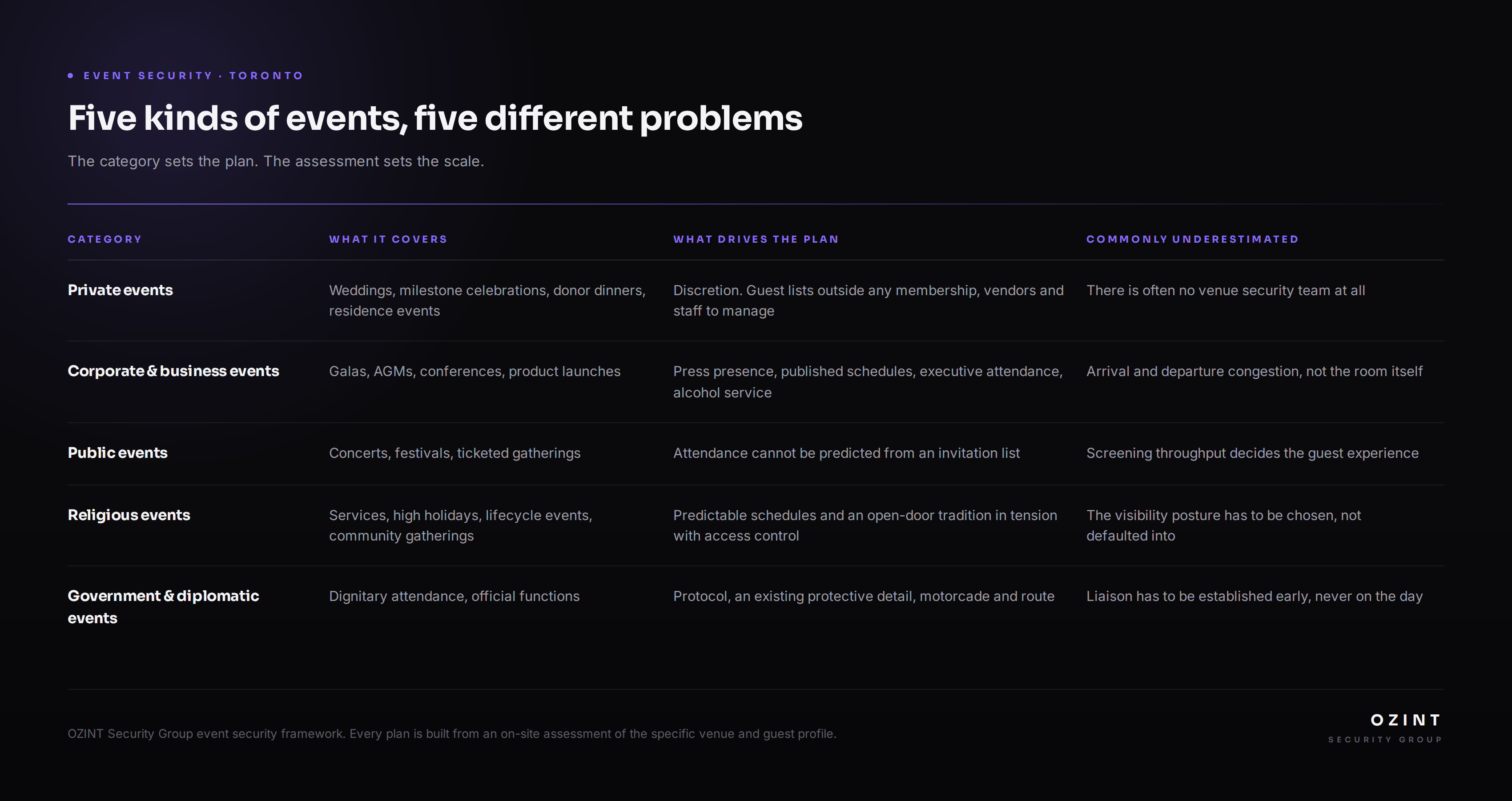
Weddings, milestone celebrations, donor dinners, events at a private residence. Discretion is the deliverable. Guest lists sit outside any membership, caterers and vendors need managing as carefully as guests, and there is frequently no venue security team at all. We cover these through private sector security.
Galas, AGMs, conferences, product launches, holiday parties. Press presence, a published schedule, executive attendance and alcohol service each reshape the plan. The room is usually the easy part. Arrival and departure are where corporate events are actually exposed. See corporate sector security.
Concerts, festivals, ticketed gatherings. Attendance cannot be predicted from an invitation list, which makes screening throughput and crowd flow the central design problem. Get the queue geometry wrong and you have created the incident you were hired to prevent.
Services, high holidays, lifecycle events and community gatherings at synagogues, churches, mosques and temples. These carry a tension worth naming: a predictable schedule and an open-door tradition sit directly against access control. Congregations include elderly members and children. The visibility posture has to be chosen deliberately, because some communities want presence to be seen and others need precisely the opposite, and both are legitimate.
Dignitary attendance and official functions. Protocol applies, a protective detail or police escort may already be in place, and motorcade and route considerations enter the plan. Liaison here is established early, never on the day.
Before anything is priced, we want a conversation. What is the event, who is attending, where is it, what is the guest profile, what has the venue agreed to provide, what is the host worried about, and what tone do they want the evening to carry.
That conversation produces the plan: staffing levels, equipment, posts, credential structure, escalation path and contingencies. It is written down, because a plan nobody can read is a plan nobody can follow.
For most events, the physical site assessment then happens on arrival, in the hour before doors, which is covered in detail below. For larger events, higher-risk guest profiles or complex venues, we carry out a full advance site assessment on a separate visit. That is available for any event and we recommend it whenever the venue is unfamiliar, the footprint is large, or a principal with elevated exposure is attending.
Where an event warrants pre-event intelligence on a specific concern, that work runs through private investigations rather than being improvised by the event team.
Almost everything that goes wrong at an event announces itself first. The job is being positioned to see it and trained to act while it is still small. Our operators work to behaviour and environment, never appearance.
None of that requires drama to address. Most of it is resolved by an operator repositioning, a door being closed, or a quiet word. That is the point.
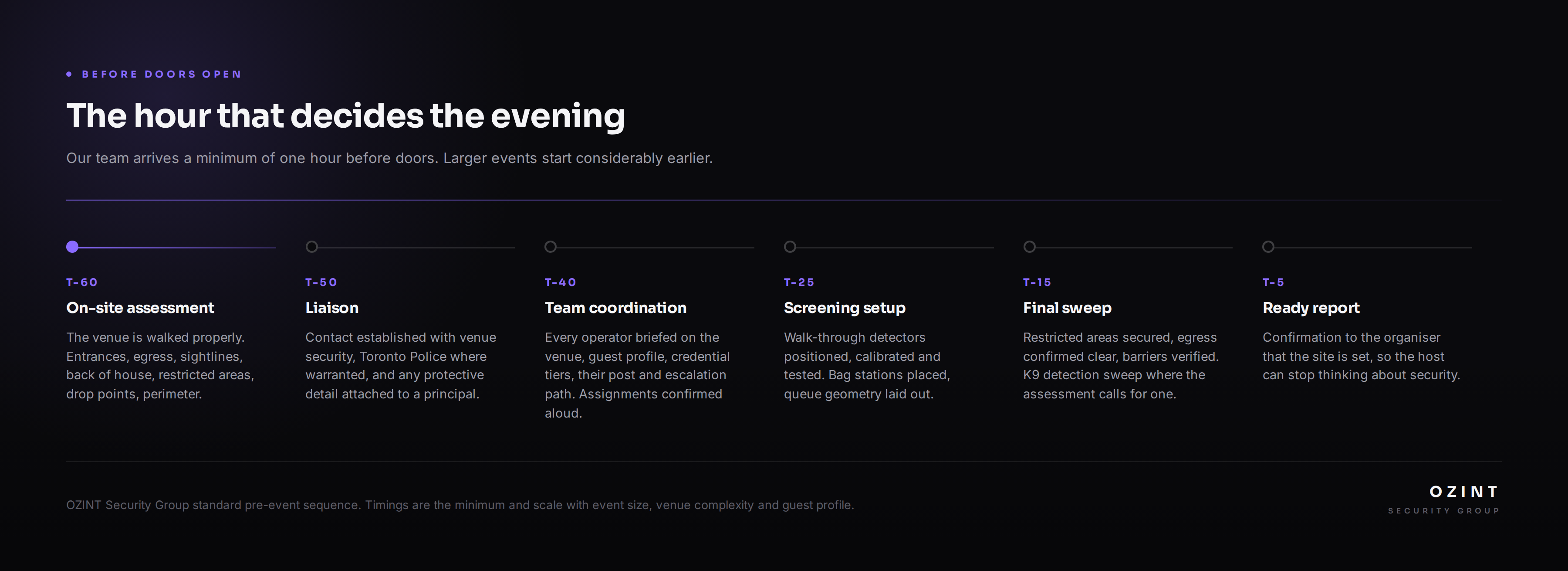
Our team arrives a minimum of one hour before doors open. Larger or higher-risk events start considerably earlier. That hour runs to a sequence, and it is the part of the service most clients have never seen another provider perform.
View OZINT Security Group in action at a recent high-profile influencer event in Toronto.
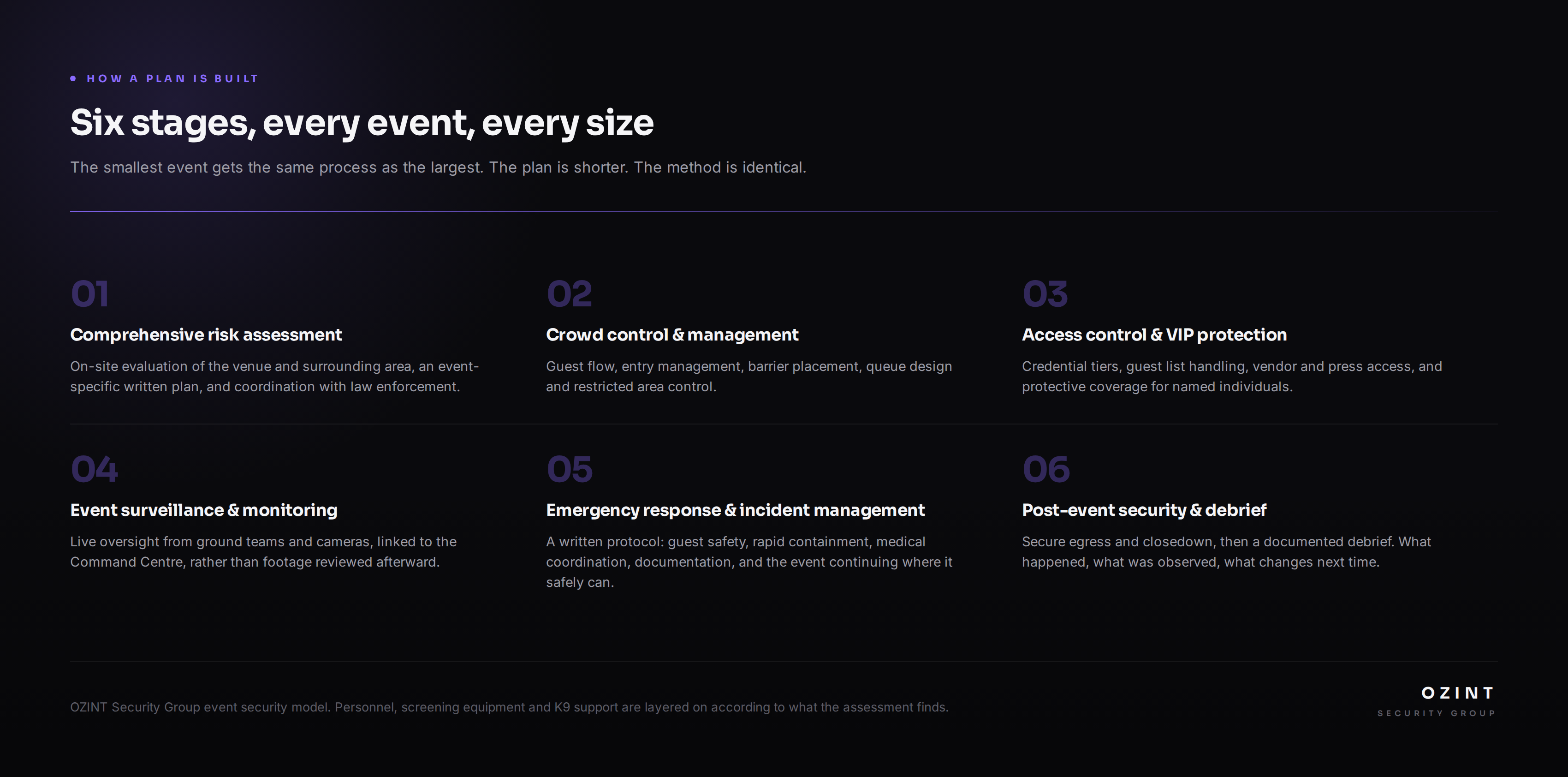
The planning conversation, the written event-specific plan, the on-site assessment and the coordination with law enforcement. Everything downstream is shaped by what this stage finds. A provider quoting a headcount before understanding the event is quoting a guess, and the client pays for the guess either way.
Guest flow, entry management, barrier and fencing placement, queue design and restricted area control. Crowd control is largely an architectural problem solved in advance rather than a staffing problem solved on the night.
Credential tiers, guest list handling, late additions and plus-ones, staff and vendor access, press management, and protective coverage for named individuals inside the event. Where a principal arrives with an existing detail, the handoff is defined during liaison rather than negotiated at the door.
Live oversight rather than footage reviewed afterward. Ground teams and camera coverage feed our Command Centre, which is what turns an observation into a decision while the observation still matters. A standing monitoring operation is the difference between an event deployment and a staffing booking.
A written protocol. Guest safety first, rapid containment, medical coordination where needed, documentation throughout, and the event continuing where it safely can. Who makes the call and how it travels is settled before the event, not during it.
Secure egress and closedown, then a documented debrief: what happened, what was observed, what changes next time. It turns a single booking into an improving program and leaves the client with a record. Our approach to documentation runs through our reports and resources.
Attire is a security decision and we treat it as one. Our operators can present in business attire or black tie, matched to the venue and the event, so that coverage reads as part of the evening rather than imposed on it. At a gala or a private celebration this is usually the right call, because a visible cordon changes how guests behave and how the host's event feels.
Where the situation calls for it, we deploy in tactical presentation instead. Public events, elevated-risk profiles, perimeter and outdoor work, and situations where visible deterrence is the point all warrant it. For community and religious institutions the choice carries real weight in both directions, and it is a conversation we have with the client rather than a default we apply.
An operator identifies a developing problem. It goes to the supervisor on a defined channel. The response is proportionate and quiet. The guest is moved rather than confronted, usually to a corridor or an anteroom, and the room generally never knows anything occurred.
Escalation to police or medical runs on a defined trigger rather than a judgement call made under pressure by whoever happens to be standing there. Everything is documented as it happens, which matters later for the client, their venue and their insurer.
De-escalation is the primary skill, not the fallback. The measure of a good outcome is that the event continued and most people never noticed.
We deploy Garrett Paragon units. The capability that matters is accurate detection of weapons and prohibited items at a throughput that keeps a queue moving, because a screening point that creates a twenty-minute line has already damaged the event it was meant to protect. Zero Touch operation means guests walk through without divesting. Two hundred sensitivity levels let the unit be tuned to the venue rather than run at a default. Quick-Q, AmbiScan and bilateral detection together mean faster processing and a clearer indication of where on a person an alarm originated, which reduces secondary screening.
Units are available within a full security package or as a standalone rental. See event security and equipment rentals.
Secondary screening, spot checks, and venues where a walk-through unit cannot be installed. Operated by trained screening personnel rather than volunteers handed a wand.
Explosive detection, narcotics searches and crowd management support. Three things worth knowing. Timing: a detection sweep belongs in the pre-doors window, clearing a space before it fills. Setting: teams work ballrooms, halls and interior venues as readily as grounds, parking areas, festival sites and perimeters. Scale: the same capability applies to a private function of eighty guests and a public event of several thousand, and what changes is the number of teams and the sweep plan, not whether it is available at all.
Queue design, perimeter definition and the separation of guest flow from vehicle movement. Outdoor events rely on this considerably more than indoor ones.
Eighty guests in a private residence or several thousand on a festival site. A ballroom, a place of worship, a corporate office, a conference centre, a park, a parking structure, a private estate. Indoor and outdoor, and often both at the same event.
What scales is the team size, the equipment set and the sweep plan. What does not change is the method. The smallest event in our schedule gets the same on-site assessment, the same written plan and the same briefing as the largest. The plan is shorter. The process is identical.
Our operators are trained in de-escalation, emergency response, first aid and guest interaction, because an event operator spends most of a night talking to guests rather than confronting anyone. Training is continuous and scenario-driven rather than a certificate earned once and filed.
Senior supervisors with dedicated event experience are assigned to larger or higher-risk events. Everyone works inside a single command structure with a named escalation path, rather than as individuals working a shift alongside each other.
At a premium event, the difference between a trained operator and a booked body becomes visible in a single moment: how one difficult guest is handled in front of two hundred people.
Earlier planning produces better coordination with the venue and the authorities, better equipment availability, and more options in the plan. Short notice is workable through an expedited assessment, and we do it regularly. The honest trade is that a compressed timeline reduces options rather than execution quality.
OZINT provides comprehensive, in-depth risk analysis for events of every scale, from intimate private gatherings to large public occasions across Toronto and the GTA.
What separates us is that the whole capability sits under one provider. Assessment, personnel, screening equipment, K9 teams and post-event reporting come from one team working to one plan, rather than a staffing booking that leaves the client sourcing everything else and hoping it aligns on the night. Behind every deployment is a standing Command Centre and monitoring operation that an event plugs into, which a per-event staffing firm does not have.
Our operators are trained continuously rather than certified once, and we work across private, corporate, public, religious and diplomatic events. Every engagement follows the same three stages: assessment, customisation, deployment, under one command structure.
See our event security and rental services, or request a quote and we will start with a conversation about your event.
Six stages: risk assessment, crowd control and management, access control and VIP protection, event surveillance and monitoring, emergency response and incident management, and a post-event debrief. Personnel, screening equipment and K9 support are added according to what the assessment finds.
Private celebrations, corporate functions, public gatherings, religious services and events, and government or diplomatic functions. The need is set by guest profile, venue, attendance and whether the event is publicised, not by the size of the guest list alone.
Through a structured assessment considering attendance, venue layout, access points, alcohol service, VIP presence and whether the event is public. That assessment produces staffing levels, equipment requirements and response planning.
A minimum of one hour before doors. That hour covers the on-site assessment, liaison with venue security and Toronto Police where warranted, team briefing and assignments, screening setup and a final sweep. Larger or higher-risk events begin considerably earlier.
We can, and we recommend it for large events, complex venues or elevated-risk guest profiles. For most events the on-site assessment happens on arrival, in the hour before doors, following a planning conversation and a written plan prepared in advance.
It depends on attendance and density, venue footprint and entrance count, alcohol service, duration, whether the event is publicised, guest profile and what the venue already provides. The assessment produces the number. Anyone quoting one beforehand is estimating.
Yes. Garrett Paragon walk-through detectors, hand-held wands, bag inspection stations and trained screening personnel. Equipment is available within a full security package or as a standalone rental.
Yes. Walk-through and hand-held units can be rented individually. We recommend trained screening personnel alongside them, because a detector operated incorrectly produces delays and false confidence in equal measure.
For explosive detection, narcotics searches and crowd management support. Detection sweeps are completed before doors open rather than during the event, so a space is cleared before it fills. Teams work indoor venues and outdoor sites equally.
Attire is matched to the venue and the event. Operators can present in business attire or black tie so coverage reads as part of the evening, or in tactical presentation where visible deterrence, perimeter work or an elevated risk profile calls for it. It is a client conversation, not a default.
Yes, and frequently both at the same event. Outdoor sites add perimeter definition, lighting, weather contingency and crowd movement planning. The method is identical, the equipment set and team size change.
Yes. Liaison with venue security or operations, with Toronto Police where the event warrants it, and with any protective detail already attached to an attending principal, is completed before doors open. Radio channels, contacts and contingency plans are aligned in advance.
A defined protocol runs: guest safety first, rapid containment, medical coordination where needed, documentation throughout, and the event continuing where it safely can. Escalation to police or medical runs on a set trigger rather than an on-the-spot judgement call.
As early as possible, particularly for large or high-profile events, because earlier planning produces better coordination and equipment availability. Short-notice requests are accommodated through an expedited assessment.


