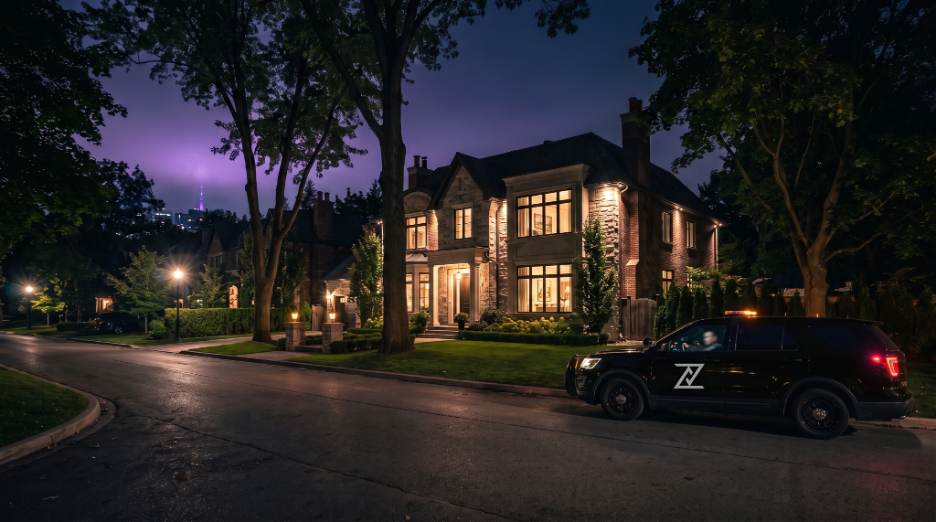
OZINT Overwatch™ is a premium zone-based home security and protection program, designed for proactive threat detection and prevention.
July 2, 2026
Most home security simply responds after something happens. Overwatch™ is built to make sure it never gets that far. It's a zone-based residential security program designed around detecting and interrupting threats before they reach your door, not just reacting once they do.
That starts with systematic, layered coverage. Every zone is staffed by multiple operators trained from backgrounds in military service, specialized law enforcement, and close protection, stationed with deliberate overlap so professionals are always close to any home in the zone. That layered presence is what lets patrol detect a threat early. If a response is still needed, our team responds in 90 seconds, with every operator within range converging on the location, so you get a coordinated unit, not a single untrained responder.
The program is currently active in Forest Hill, Rosedale, and Summerhill, with additional Toronto areas coming soon. It integrates three layers, AI-assisted surveillance, dedicated ground patrol, and a live 24/7 Security Operations Centre, into a single, coordinated protection service that treats your home and the surrounding neighbourhood as one connected environment.
It operates on a subscription basis with multiple plan options available, followed by a property assessment specific to your home.
Most homeowners know the standard arrangement: a keypad on the wall, a few cameras at the front door, and a monitoring company that calls if a sensor trips in the night. You confirm it's not an emergency. They contact the police if you don't answer. By the time anyone arrives - 13 to 30 minutes depending on priority and area, according to Toronto Police Service response data, the situation has already resolved itself one way or another.
There's a second, quieter problem with conventional monitoring. The same TPS data shows that 97% of residential alarm activations turn out to be false. Trigger four false alarms in any 365-day period and TPS can suspend police response to your address entirely; panic button activations are explicitly exempt from that count. A system that dispatches on every unverified sensor trip isn't only slow. It's quietly spending down your household's standing with the one service you're counting on for the emergency that's real.
For most of the city, this is adequate. For homeowners in Forest Hill, Rosedale, and Summerhill, it isn't.
The reason is due to who targets these neighbourhoods. A Globe and Mail analysis of a decade of Toronto Police data found that while citywide break-and-enters fell 27% between 2015 and 2025, Rosedale-Moore Park rose 145% and Yonge-St. Clair rose 236% over the same period. York Regional Police's Project Dusk in February 2025 resulted in 20 arrests involving individuals who, according to investigators, had entered Canada specifically to commit residential property crime. They plan. They observe. Then they act when the window of opportunity is open.
A camera records that window. A monitored alarm notifies someone after it closes. Neither one prevents what happens inside it. Zero deterrence, zero human patrol response.
From Surveillance to Intervention: Why Cameras Alone Do Not Stop Crime
Ask a homeowner what scares them most, and the answer is almost always the same: a home invasion or security emergency.
The home security industry has spent years selling a promise that doesn't quite hold up: faster monitoring and faster response times equal better security. It isn't wrong, so much as incomplete. In a real home invasion, the people involved are rarely alone. They operate in coordinated groups, and by the time anyone needs to respond, the most dangerous moment has already passed. A faster arrival helps. It rarely stops it.
Overwatch™ is built on a different premise: a prevention-first model, not a reaction-first one.
That starts with how the three layers work together rather than in sequence. AI-assisted cameras flag anomalies for live review. The Security Operations Centre verifies what's actually happening on a live feed. Ground patrol operators, already stationed in the zone, are trained to notice what doesn't belong - a vehicle circling more than once, someone testing a gate, movement that doesn't fit the neighbourhood's normal pattern - and to act on it before it becomes an incident.
In practice, that means operators are often two steps ahead: providing protection while a homeowner isn't even aware a threat was ever close by. This is also why Overwatch™ zones are built around overlapping coverage. Individual operators, each covering roughly 300 metres, are stationed across your zone so multiple sets of eyes are always within reach of any home, layered deliberately rather than simply spaced to cover ground. That overlap shortens response time when something does happen, and that still matters. But its primary purpose is prevention: more coverage across a zone means more opportunities to notice and interrupt a threat before it ever reaches a doorstep.
When a response is still required, Overwatch™ never sends a single operator. Because operators are stationed with overlapping coverage across your zone, a confirmed emergency brings every operator within range converging on the location, not one responder, but a coordinated unit arriving together. But that response is the fallback, not the plan. The plan is detecting and preventing the incident before it starts.
Overwatch™ is not a camera upgrade or a smarter alarm panel. It is a security program built from three operational layers: Technology, Ground Force, and Command Centre. Each designed to address a specific gap that conventional security leaves open. The three layers work together continuously as one integrated system.
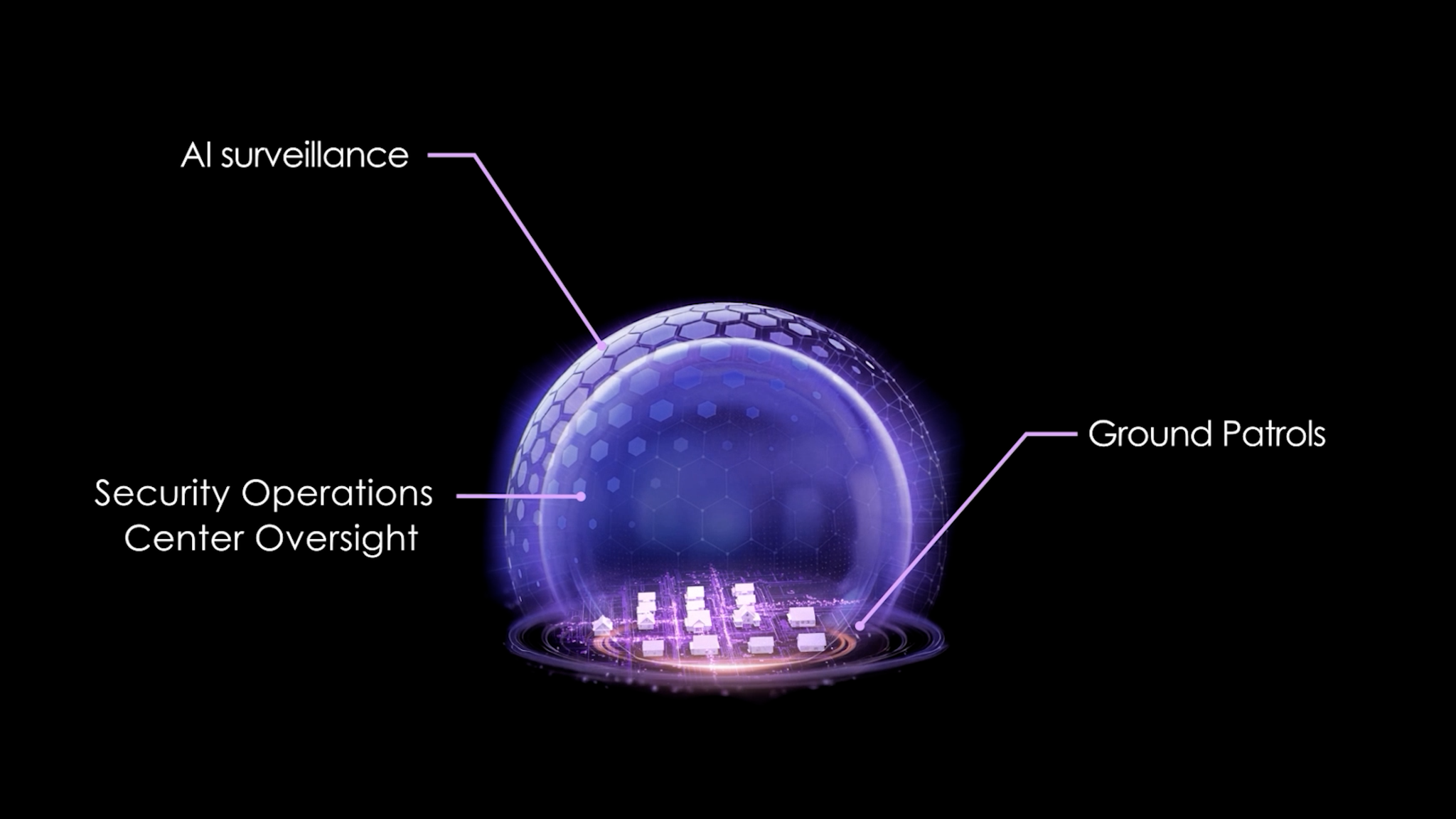
Every Overwatch™ deployment includes AI-assisted camera infrastructure connected directly to OZINT's live monitoring operation. Cameras are not recording passively. Trained SOC operators review live feeds, and AI-assisted detection surfaces anomalies for immediate human review.
Overwatch™ SOC monitoring runs on hardware that meets OZINT's technical standards for live verification and Security Operations Centre integration.
Most existing alarm panels, doorbell cameras, and consumer sensor systems don't meet that bar. On Emergency Only, your existing alarm and camera system stays exactly as it is, running independently alongside Overwatch™. On Enhanced Protection and Ultimate Protection, a system that already meets SOC standards connects directly; where it doesn't, OZINT installs dedicated high-grade cameras built to meet those standards for live monitoring. Either way, your original system can keep running. It simply isn't the system the SOC is watching.
Panic buttons are installed at multiple points within the home and connect simultaneously to the Security Operations Centre and the assigned patrol unit the moment they are activated. No relay to a third-party call centre. No waiting. The response begins when the button is pressed.
AI vs Human Judgment: What Technology Can Detect and What Only Trained Operators Can Sense.
A dedicated mobile response unit operates within your Overwatch™ protection zone throughout all covered hours. This unit is not part of a city-wide fleet spread across Toronto. It's assigned to a defined neighbourhood area and operates continuously within it - forming a protected zone around homes.
Zone coverage isn't built around a single patrol unit. Each operator covers an effective radius of roughly 300 metres, and every zone is staffed with multiple operators stationed with deliberate overlap, not just spaced to cover the area, but layered so several are always within reach of any given home. That overlap does double duty: it's what lets patrol notice a threat early, and it's what turns a single confirmed emergency into a multi-operator response. When something is confirmed, every operator within range converges on the location. You're never getting one person. You're getting however many the situation actually needs.
Our response target is 90 seconds from detection to physical arrival. That target is achievable only because the unit is already in Forest Hill, Rosedale, or Summerhill before anything happens, not being dispatched from somewhere else after it does.
The operators who run these units come from backgrounds in military service, specialized law enforcement, and close protection. Under Ontario's Private Security and Investigative Services Act, there are no mandated ongoing training standards after initial licensing - companies set their own, or none at all. OZINT enforces a continuous, scenario-based training program developed internally. In an industry where post-licensing training is largely optional, that distinction matters when something actually happens.
Between incidents, patrol is active rather than passive. Operators map each zone, identify blind spots, monitor access routes, and maintain a continuous picture of the neighbourhood they're covering.
What Military Experience Really Adds to Civilian Security.
OZINT's Security Operations Centre runs 24/7. It is OZINT's own operation, not a contracted call centre, or an outsourced monitoring service.
When an alert arrives, the SOC operator immediately accesses the live camera feed and visually confirms what is happening. This step eliminates wasted response time on false alarms and ensures the patrol unit is dispatched to a confirmed situation, not a sensor glitch. It also means your household's alarm history stays clean: verified dispatches don't count against TPS's four-false-alarm suspension threshold the way unverified sensor trips do.
When police or EMS involvement is appropriate, the SOC coordinates that directly. Homeowners do not navigate 911 from the middle of an emergency. Every incident is managed from detection through to resolution and documented in full.
The three layers overlap and are connected end to end. An alert reaches the SOC. The operator visually verifies it. The ground unit is dispatched or already in motion. Police or EMS coordination is initiated if needed. The homeowner is notified while the response is underway, not after it's over.
Confirm zone availability and find the right protection tier for your home.
The real test of any security program is what it does when something is actually happening. Here is how the Overwatch™ response unfolds in practice.
Detection. An event is identified through one of four channels: a live camera alert, a panic button activation, a direct observation by the patrol operator, or a resident notification. All four route to the SOC instantly.
Visual verification. The SOC operator accesses the live camera feed for the relevant property and assesses the situation in real time. A trained professional has eyes on your property within seconds of the alert.
Threat classification. The operator classifies the situation within seconds. Confirmed threat or precautionary response or false positive. The classification determines what's deployed and how fast.
Ground unit dispatch. For confirmed incidents, the patrol unit is dispatched immediately or is already moving. The distance it needs to cover is measured in streets, not kilometres.
Police and EMS coordination. When required, the SOC initiates that coordination directly. You do not call 911. You do not wait on hold. OZINT manages the liaison and provides responding services with a verified account of what is happening as they approach.
Homeowner notification. You are notified of the incident and the response is already in progress. Information arrives while the situation is being managed, not as a summary afterward.
Documentation. Once the incident is resolved, a formal report is generated covering the detection source, timeline, SOC actions, ground unit actions, any police or EMS involvement, outcome, and follow-up recommendations. You have a complete professional record of everything that happened.
By the time a conventional call centre has finished its phone chain, the Overwatch™ operator is already on site.
Overwatch™ does not just protect your property. It operates across your neighbourhood as a defined zone.
When your home joins Overwatch™, it becomes part of a connected protection environment covering your property, your immediate street, and the surrounding community. Patrol units are not stationed at your front door. They are active throughout the zone, monitoring access routes, entry points, and adjacent properties continuously.
This is how OZINT delivers faster response times than competitors operating city-wide fleets. The unit covering Forest Hill is in Forest Hill. When your alert fires, it is already close.
OZINT actively manages the number of homes per zone to preserve that capability. When a zone reaches its operational limit, it is capped.
This is not standard industry practice. It's also what preserves the overlapping operator coverage described earlier: once a zone is full, response density doesn't degrade. Coverage ratios are frequently stretched as client volume grows. OZINT's position is that a response time commitment is only worth making if the operational model actually supports it.
Each zone also benefits from web intelligence monitoring (WEBINT), ongoing risk assessment of neighbourhood-level threat patterns, and a resident communication channel through which homeowners share observations directly with the command centre. Your home is better protected when your street is better protected. The program is built on that principle.
7 Things Forest Hill Homeowners Should Know Before Hiring Security.
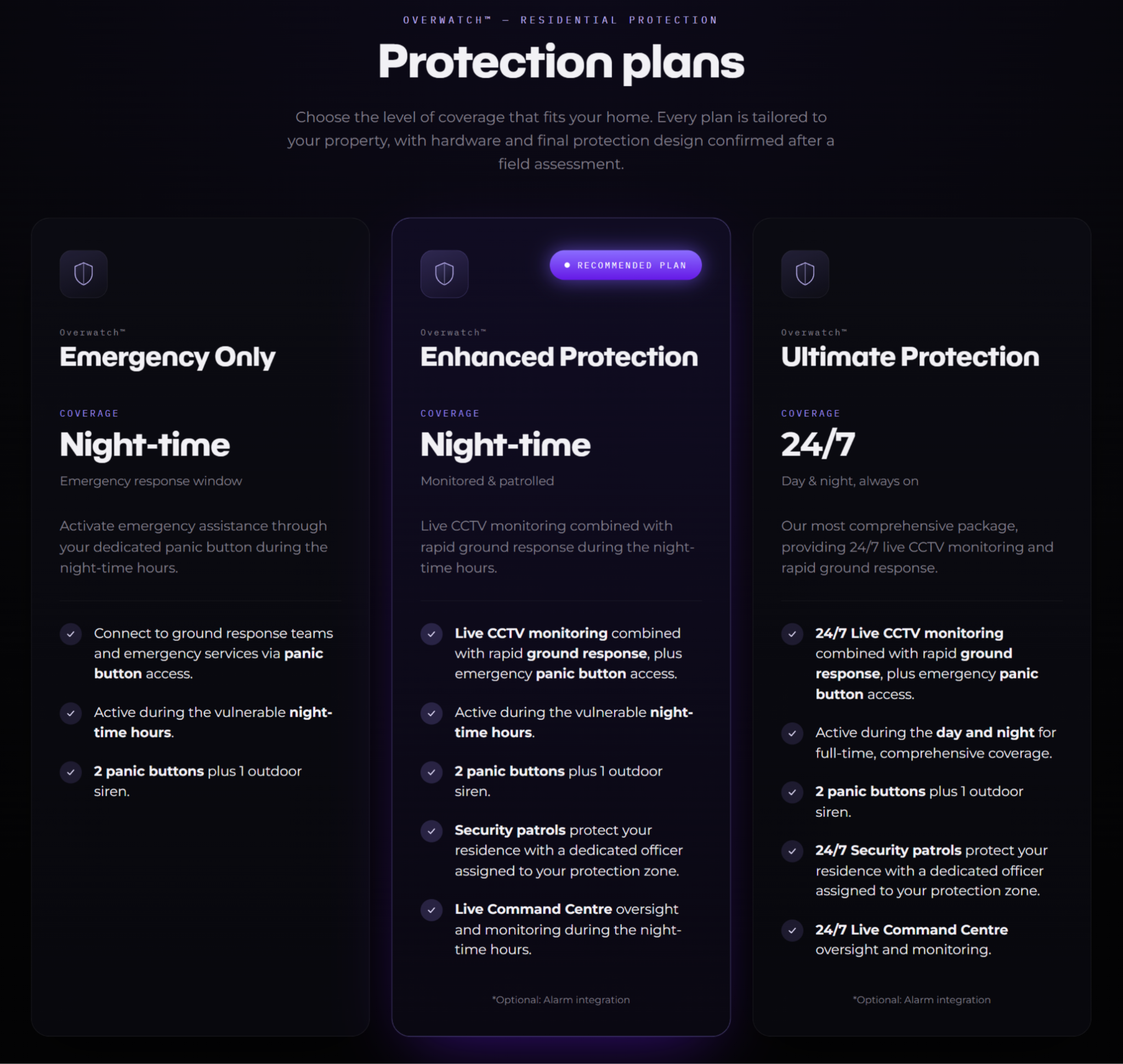
Every plan is confirmed following a property assessment, with hardware, installation, and configuration handled entirely by OZINT. Overwatch™.
Night-time coverage
Activate emergency assistance through your dedicated panic button during the night-time hours.
Night-time coverage
Live CCTV monitoring combined with rapid ground response during the night-time hours.
Day & Night 24/7 coverage
Our most comprehensive package, providing 24/7 live CCTV monitoring and rapid ground response.
Overwatch™ is a premium program designed for specific households. Being direct about that serves everyone better.
New and established homeowners in Forest Hill, Rosedale, and Summerhill whose properties and lifestyles have outpaced what conventional alarm monitoring was built to protect. These families want real protection and genuine discretion - a service that integrates cleanly into the neighbourhood and responds decisively when needed.
Frequent travellers and executives who spend significant time away and want verified oversight by a team that can act on what they see, not just a camera feed to check remotely.
Families with children where kids may be home during evening hours without all adults present. The confidence here is knowing that if something happens, an operator has already seen it and a unit is already moving.
Snowbirds and homeowners with seasonal residences whose Toronto properties sit unoccupied for extended periods. Overwatch™ functions identically whether or not the home is occupied. The SOC maintains live oversight and the patrol unit covers the zone year-round.
Homeowners with elderly family members for whom the ability to reach trained help immediately through a panic button, connected directly to a response team, not a call centre. That can be the difference that matters.
A property assessment confirms your zone, your risk profile, and which plan fits.
The process involves three steps and no upfront commitment.
Book a discovery consultation. OZINT's team confirms whether your address falls within an active protection zone, walks through which plan tier fits your situation, and answers essential questions on your existing security setup.
Complete the property assessment. Once you join as a new Overwatch™ program member, OZINT visits your property, conducts the evaluation, and produces a protection design specific to your home. This step is required before the final plan confirmation and activation.
Your protection activates. Hardware is installed, your home is integrated into the SOC monitoring environment and assigned patrol zone, and the program goes live.
Overwatch™ is currently active in Forest Hill, Rosedale, and Summerhill. Additional Toronto areaswill be added in the months ahead. If your area is not yet listed, contact OZINT to register your interest and receive priority notification when coverage expands to your community.
How is Overwatch™ different from my current alarm monitoring service?
Your current service sends an alert to a third-party call centre when a sensor triggers. That agent contacts you, then calls police if required - no visual confirmation, no ground presence, a timeline measured in minutes. Overwatch™ operates differently on each of those dimensions. The SOC visually verifies every alert on live camera, and the patrol unit assigned to your zone is already operating in your neighbourhood before any alert is triggered.
What makes Overwatch™ unique compared to alternatives?
Most providers compete on speed. Overwatch™ is built so it never gets that far. All three layers work for prevention, not just speed. AI-assisted cameras and live SOC verification catch what a homeowner can't see, while ground patrol, stationed roughly every 300 metres with overlapping coverage, is trained to interrupt a threat before it reaches your door. If a response is still needed, every operator within range converges on the location, a coordinated unit, not a single responder.
How many operators respond if there's an emergency?
Overwatch™ never sends a single operator. Zone coverage is built from individual operators, each stationed within roughly 300 metres of the homes around them, deliberately overlapping so several are always close to any point in the zone. When an emergency is confirmed, every operator within range converges on the location at once. You get a coordinated, multi-operator response, not one person arriving alone.
What is the actual response time?
The target is 90 seconds from detection to physical arrival on site. That's achievable because the patrol unit operates continuously within a defined neighbourhood zone - when your alert fires, it's not crossing the city. It's already close.
What happens when I press the panic button?
An immediate simultaneous alert goes to the OZINT SOC and the assigned patrol unit. The SOC operator accesses your live camera feed and assesses the situation. The patrol unit begins moving. If police or EMS are required, the SOC coordinates that directly. You do not need to call anyone.
Does Overwatch™ replace my existing security system?
No, not the way most alarm companies mean it. SOC monitoring only runs on hardware that meets OZINT's technical standards, and most existing alarms and cameras don't qualify. Your current system can stay in place as an added layer. Depending on the plan you choose, a qualifying system connects straight to the SOC; if yours doesn't qualify, OZINT installs dedicated cameras that do. Panic buttons are new hardware on every plan and connect directly to the SOC and patrol unit no matter what else is installed.
My home already has high-quality cameras. Do I still need Overwatch™?
The relevant question is what happens after the camera captures something. Without a team actively watching live feeds and a response unit close enough to act on what they see, footage is evidence after the fact - not protection in the moment. It's also worth knowing that most consumer cameras, even high-end ones, don't meet the technical standard required for live SOC monitoring. On Enhanced and Ultimate Protection, OZINT installs dedicated cameras built to that standard; your existing cameras can keep running alongside them.
Which plan is right for my home?
The Enhanced Protection plan is the most commonly chosen for established homeowners in Forest Hill, Rosedale, and Summerhill - live monitoring, dedicated physical presence, and Command Centre oversight during the hours when residential risk is highest. The property assessment produces a specific recommendation based on your actual situation.
Am I locked into a long-term contract?
No. Overwatch™ membership is available on 3-month, 6-month, and 12-month terms, so you choose the commitment level that fits your household. There is no multi-year lock-in required for any protection tier.
What if I need fully dedicated, 1-on-1 coverage?
Homeowners with an elevated risk profile, or who want a single operator assigned exclusively to their residence, can discuss a custom deployment during their property assessment. OZINT scopes bespoke coverage outside the standard tiers for households that need it.
Can Overwatch™ cover a home that's vacant for extended periods?
Yes. The SOC maintains continuous oversight of your camera feeds regardless of whether the property is occupied. The patrol unit covers the zone around the clock. Overwatch™ functions identically for vacant and occupied homes.
Who are the operators working in my neighbourhood?
Overwatch™ operators are selected from backgrounds in military service, specialized law enforcement, and close protection. OZINT's selection and ongoing training standards significantly exceed Ontario's minimum licensing requirements. All operators complete continuous scenario-driven training developed and maintained internally by OZINT.
Is Overwatch™ available in my neighbourhood?
Currently active in Forest Hill, Rosedale, and Summerhill. Additional Toronto neighbourhoods are being added. If you live outside the current active zones, contact OZINT to register your interest and receive priority notification when your area launches.
Written by Zohar Haimov, founder and CEO of OZINT Security Group — providing close protection, residential and neighbourhood security, event security, private investigations, and dedicated patrols for Toronto's premium communities.


