
What private and corporate security covers in Toronto, who needs it and when, which licences to verify, and the essential questions to ask while considering options.
October 1, 2026
Private and corporate security in Toronto covers seven distinct services: residential and estate protection, executive and close protection, secure transportation, event security, corporate risk assessment, investigations and intelligence, and community and institutional protection. The right service is determined by what is exposed, who is exposed and for how long, not by the size of the organisation. In Ontario, any provider you hire must hold an agency licence under the Private Security and Investigative Services Act, 2005, and every individual working under it must be licensed as well.
Four reasons, in the order they usually become urgent.
Police resources are allocated by priority, and in Toronto they are allocated only after an event is verified. Since 10 September 2018, the Toronto Police Service has operated a verified response model for burglar alarms, meaning an alarm alone does not produce a dispatch. Private security is not a substitute for police. It is what determines whether police are dispatched at all, and what happens in the interval before they arrive.
Under Part III.0.1 of the Occupational Health and Safety Act, every Ontario employer must prepare a written workplace violence policy, implement a programme, and assess the risks of workplace violence arising from the nature of the workplace, the type of work and the conditions of work. That is not optional and it does not depend on headcount. Most organisations discover the obligation during an inspection or after an incident, which is the most expensive moment to discover it.
A security failure lands as a legal exposure, an insurance exposure, a continuity interruption and a reputational event at the same time. An intrusion at a facility is also a data question. An incident involving an executive is also a governance question. Organisations that treat security as a facilities line item tend to be the ones paying for it three times.
Executives work from home. Home addresses are findable. Deliveries, contractors, staff and family movements make a residence a far busier access point than most people assume. The same is true in reverse: an issue that begins at a residence does not stay there. If a household with high-value vehicles is part of the picture, the driveway is usually the least protected part of the property.
Three broad categories, each with a different centre of gravity.
HNW and UHNW households, estate owners, founders, executives, public figures, and families with significant travel, staff or vehicle exposure. The concern is usually the home, the people inside it, and movement between locations. Family offices typically procure on behalf of a principal and need documentation and discretion in equal measure.
Corporates, professional services firms, developers, retail and industrial operators, and any Ontario employer carrying the OHSA duty above. The concern is people, premises, information and continuity. This category includes organisations with no perceived threat at all, because the assessment obligation exists regardless.
Synagogues, schools, community centres, places of worship and campuses. The concern is a shared facility used by many people on a predictable schedule, often with funding or insurance requirements attached to the security programme itself.
Security is cheapest and most effective before an incident and most expensive immediately after one. These are the moments that should trigger a call.
The pattern across all eight: something changed in the exposure, not in the threat. That is the right moment to assess.
The phrase is doing too much work. Two very different industries operate under the same label in Toronto, and confusing them is the most expensive mistake a buyer makes.
Contract guarding supplies bodies to a location. It is priced per hour, scaled by headcount, and measured by presence. It is the right answer for access control, lobby coverage, parking enforcement and site deterrence, and it is a legitimate service well delivered by good firms.
Intelligence-led protective services begin with an assessment of what is actually at risk and design a system around that finding. Personnel are one component. Technology, monitoring, response, protocols and reporting are the others. It is measured by whether risk was reduced, not by whether someone was standing somewhere.
These two things are not comparable on price, and quotes from each will look wildly different for what appears to be the same brief. If you are comparing a guarding quote against a protective services quote, you are comparing an hourly rate against a risk outcome. Decide which one you are buying before you look at a number.
Seven services, what each protects, and what usually triggers the call.
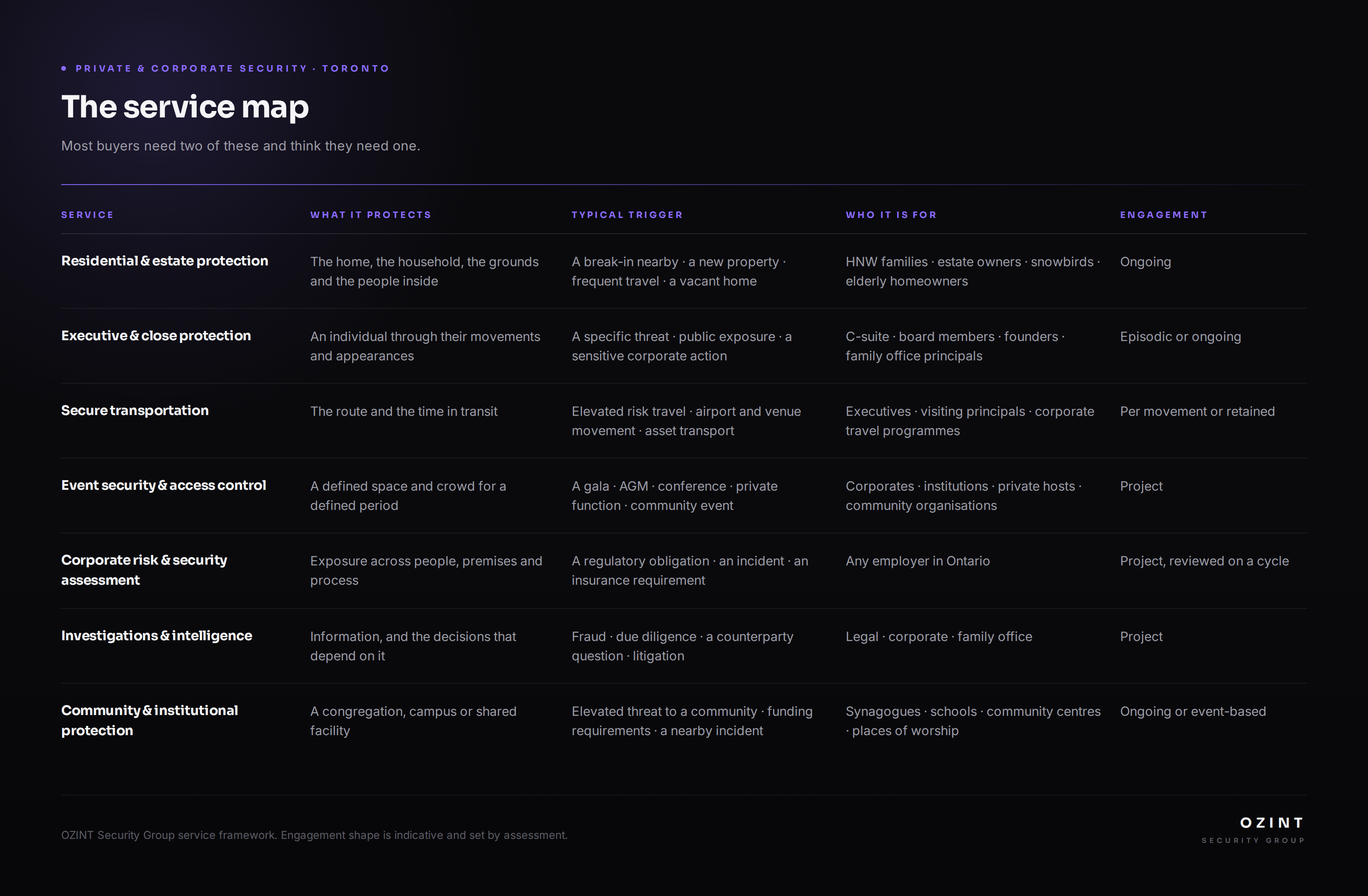
Most buyers need two of these and think they need one. An executive with a known home address has both a corporate exposure and a residential exposure, and treating them as separate procurements is how gaps appear between them. If the household is the part you are least sure about, start with the questions worth asking any residential provider.
The most common failure. An organisation feels exposed, requests a quote, and buys coverage. Six months later nobody can say whether risk went down, because nobody defined what was at risk in the first place. An assessment costs a fraction of a year of coverage and frequently reduces the coverage required.
An operator at a door does not fix an access control failure, an unmanaged visitor process, a key register nobody maintains or a termination procedure with no security step in it. Personnel deployed against a process problem become a permanent, expensive patch.
Corporate security protects the executive at work. Residential security protects the family at home. They are the same person, and the exposure travels with them. Where these are procured separately, there is usually no shared protocol for the moment one becomes the other.
"The mistake I see most often is a company buying hours before it has bought an assessment. They hire people to stand somewhere, and six months later they find out the thing they were actually worried about was never going to walk through that door. Start with what is exposed. The staffing answers itself." - Zohar Haimov, Founder and CEO, OZINT Security Group
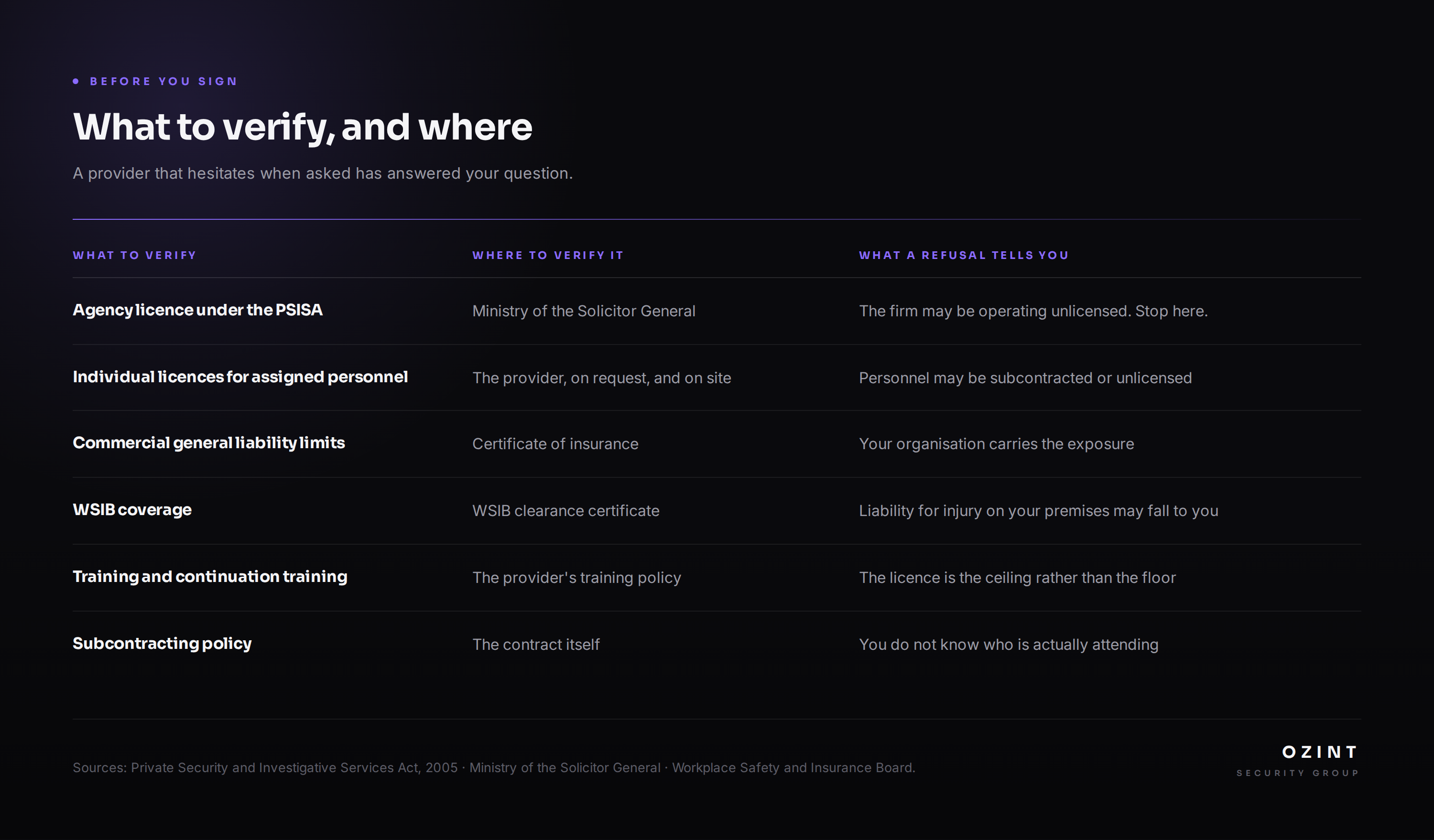
This section is the one to read before you sign anything.
Under the Private Security and Investigative Services Act, 2005, any business supplying security guard or private investigator services in Ontario must hold an agency licence, and every individual performing that work must hold an individual licence. Both are administered by the Ministry of the Solicitor General through its Private Security and Investigative Services Branch, which also runs the public complaints portal. Licence status is verifiable, and a provider that hesitates when asked to produce licence details has answered your question.
The Act and its regulations also govern uniform and identification requirements, a code of conduct, and the obligation for a licensed individual to produce their licence on request. Ask how your provider handles that in the field, because it is where policy meets practice.
Ask for a certificate of insurance showing commercial general liability limits, and confirm WSIB coverage for the personnel who will attend your site. Where a provider engages subcontractors, ask specifically whether those limits extend to them.
Under Part III.0.1 of Ontario's Occupational Health and Safety Act, every employer must prepare a written workplace violence policy, develop a programme to implement it, and assess the risks of workplace violence arising from the nature of the workplace, the type of work and the conditions of work. That duty sits at section 32.0.3, added to the Act by Bill 168 in 2009. Results must be shared with the joint health and safety committee, the health and safety representative, or the workers themselves.
The practical point for procurement: your security provider's scope should be built from that assessment, not guessed at ahead of it. If you have completed one, it is the strongest brief you can hand a provider. If you have not, that is the first piece of work, and it is a legal obligation regardless of whether you hire anyone.
We do not publish rates, because a rate without a scope is a number without meaning. These are the variables that move every quote you will receive, and knowing them lets you read one properly.
One local fact reshapes how response should be evaluated here. Since 10 September 2018, the Toronto Police Service has operated a verified response model for burglar alarms. Officers do not attend on the alarm alone. Response requires real-time audio, real-time video, an eyewitness at the scene including a private security employee, or multiple zone activations. Panic, hold-up and duress alarms are exempt. The change followed a Toronto Police review finding that 97 per cent of burglar alarm calls in 2016 were false.
Alongside that, the Toronto Police Service's most recent annual reporting puts the average Priority 1 response at 14.1 minutes, improved 17.5 per cent year over year, with Priority 2 calls averaging 40.0 minutes. Current figures are published through the Public Safety Data Portal.
Two consequences for a buyer. First, an unverified system in Toronto does not produce a police dispatch, which makes live verification a functional requirement rather than a premium feature. If you want to see how the different response models compare in practice, they are set out here. Second, any provider quoting a response capability should be able to state how the number is measured and from what point the clock starts.
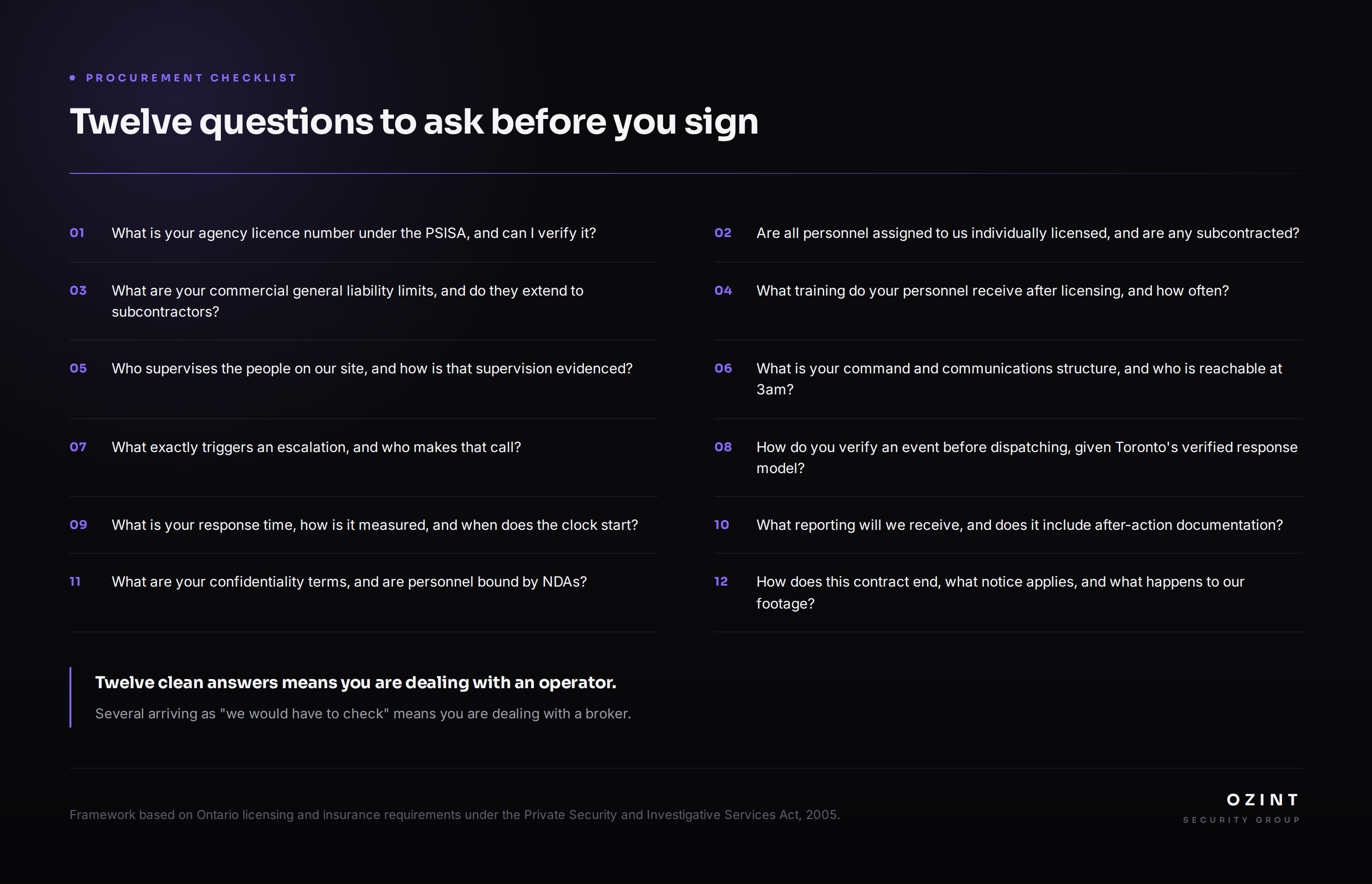
If a provider answers all twelve without hesitation, you are dealing with an operator. If several answers arrive as "we would have to check," you are dealing with a broker.
OZINT is a Toronto private security firm built around intelligence rather than headcount. We work across the full private and corporate spectrum: corporate risk and security assessment, executive and close protection, secure transportation and armoured vehicles, event security, investigations and intelligence, and community and institutional protection, alongside our residential programme, Overwatch™. These are the four pillars that separate us from other providers.
Our personnel come from military, close protection and law enforcement. They are licensed under the Private Security and Investigative Services Act, and licensing is where their training begins rather than where it ends. We train continuously across [insert programme areas: threat recognition, de-escalation, emergency medical, protective driving, report writing], because a licence proves eligibility and nothing else. The difference between a licensed individual and a trained operator is visible in the ninety seconds when something is actually happening.
Every deployment runs under written protocols with a named escalation path and a single command structure. Incidents are documented and reviewed. Clients receive after-action reporting, not a verbal summary. This is the part of the service nobody asks about during procurement and everybody relies on afterward, particularly where an insurer, a regulator or counsel needs a record of what happened and when.
We are not the lowest bid and we do not try to be. Our model carries a Command Centre that never goes offline, response units in rotation, and an operator standard that costs more to maintain. That is the trade we have chosen, and it is the right trade for clients whose exposure is not measured in hourly rates. Clients who need bodies at a door are well served by the contract guarding market. Clients who need a system that thinks are the ones we build for.
See our corporate and private security services, or book an assessment and we will start with what is actually exposed.
A private security company protects people, property, information and continuity. In Toronto that spans residential and estate protection, executive and close protection, secure transportation, event security, corporate risk assessment, investigations and intelligence, and community or institutional protection.
Because the exposure is legal, financial and operational at once. Ontario employers carry a statutory duty to assess workplace violence risk, police response is verified and finite, and a single incident lands as a liability question, a continuity interruption and a reputational event simultaneously.
Three groups: individuals and families with significant residential, travel or vehicle exposure; organisations and employers responsible for people, premises and continuity; and institutions such as schools, community centres and places of worship operating shared facilities on a predictable schedule.
Before an incident rather than after one. The usual triggers are a regulatory or insurance requirement, a planned termination or restructuring, a public-facing event, a specific threat, a nearby incident, or a change in the property or operation.
Yes. Under the Private Security and Investigative Services Act, 2005, businesses supplying security guard or private investigator services in Ontario must hold an agency licence, and every individual performing that work must hold an individual licence. Both are administered by the Ministry of the Solicitor General.
Ask the provider for its agency licence number and the individual licence details for assigned personnel, then verify through the Ministry of the Solicitor General's Private Security and Investigative Services Branch. Licensed individuals are also required to produce their licence on request while working.
Private security protects individuals, families and residences. Corporate security protects an organisation's people, premises, information and continuity. Where the principal is both an executive and a household member, the two should be designed as one plan rather than procured separately.
A licence establishes eligibility to work. Training establishes capability. A contract guard is deployed for presence and access control. A protective operator is trained continuously in threat recognition, de-escalation and response, and works inside a command structure with written protocols and escalation paths.
Cost is determined by coverage hours, personnel tier and training standard, whether response capability is included, technology integration, vehicle requirements, geography, mandate length and reporting obligations. A quote without a defined scope cannot be compared against another quote.
Every Ontario employer must assess the risks of workplace violence under section 32.0.3 of the Occupational Health and Safety Act, considering the nature of the workplace, the type of work and the conditions of work. Results must be shared with the joint health and safety committee, the health and safety representative, or workers directly.
The workplace violence assessment duty applies to Ontario employers regardless of size. Whether personnel are required is a separate question answered by the assessment. Many small operations need a process fix, a technology change or a documented protocol rather than staffing.
Only where the alarm is verified. Since September 2018, Toronto Police require real-time audio, real-time video, an eyewitness at the scene including private security, or multiple zone activations before dispatching to a burglar alarm. Panic, hold-up and duress alarms are exempt.
Yes. A licensed provider coordinates with police and EMS during an incident, and under the Toronto verified response model a private security employee on scene is itself one of the accepted forms of verification that triggers a police dispatch.
An event or short-term mandate can usually be resourced within days, subject to scope. Ongoing residential or corporate programmes should begin with an assessment, which sets a realistic timeline for design and deployment. Short-notice work carries a premium across the industry.


