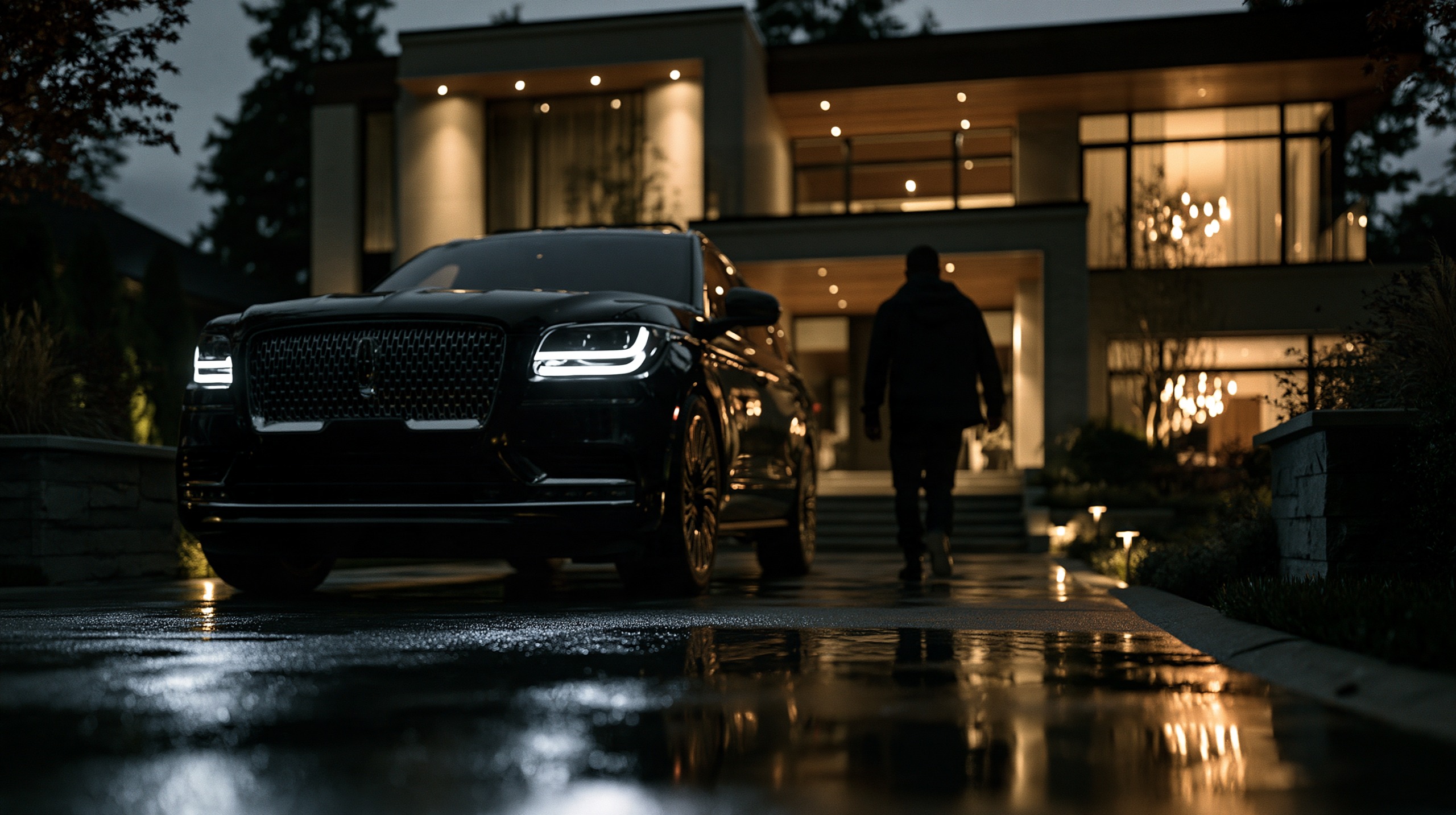
Worried about car theft? Here are the four methods used to steal vehicles from Toronto driveways, which deterrents actually work, and what Toronto Police data really shows.
September 30, 2026
By the OZINT Security Group Intelligence Team | 10-minute read
Most vehicles stolen from Toronto driveways are taken overnight using one of four methods: a relay attack on the key fob signal, a CAN injection through an exterior light or mirror, key reprogramming through the OBD port, or theft of the physical key from inside the house. A Faraday pouch defeats one of those four. What interrupts all four is detection before the person reaches the vehicle, verified by a human in real time.
The national picture has improved, and it is worth saying so plainly. Equite Association's 2025 Auto Theft Trend Report recorded 46,999 private passenger vehicle thefts across Canada in 2025, an 18 per cent decrease year over year. Ontario fell further and faster: 19,319 vehicles stolen in 2025, down 22 per cent from 24,877 the year before.
Toronto is the exception to its own province. Equite recorded a further decline across Ontario through the first half of 2026, but Toronto Police Service reported auto thefts up 8.8 per cent in the city over the same period. Ontario is improving. Toronto, this year, is not.

Two of those figures matter more than the rest. The first is the 51 per cent recovery rate, which means roughly half of stolen vehicles in Ontario are never returned to their owners. The second is the 46 per cent SUV share, because the vehicle profile that dominates driveways in Toronto's finest neighbourhoods is the same profile that dominates the theft data.
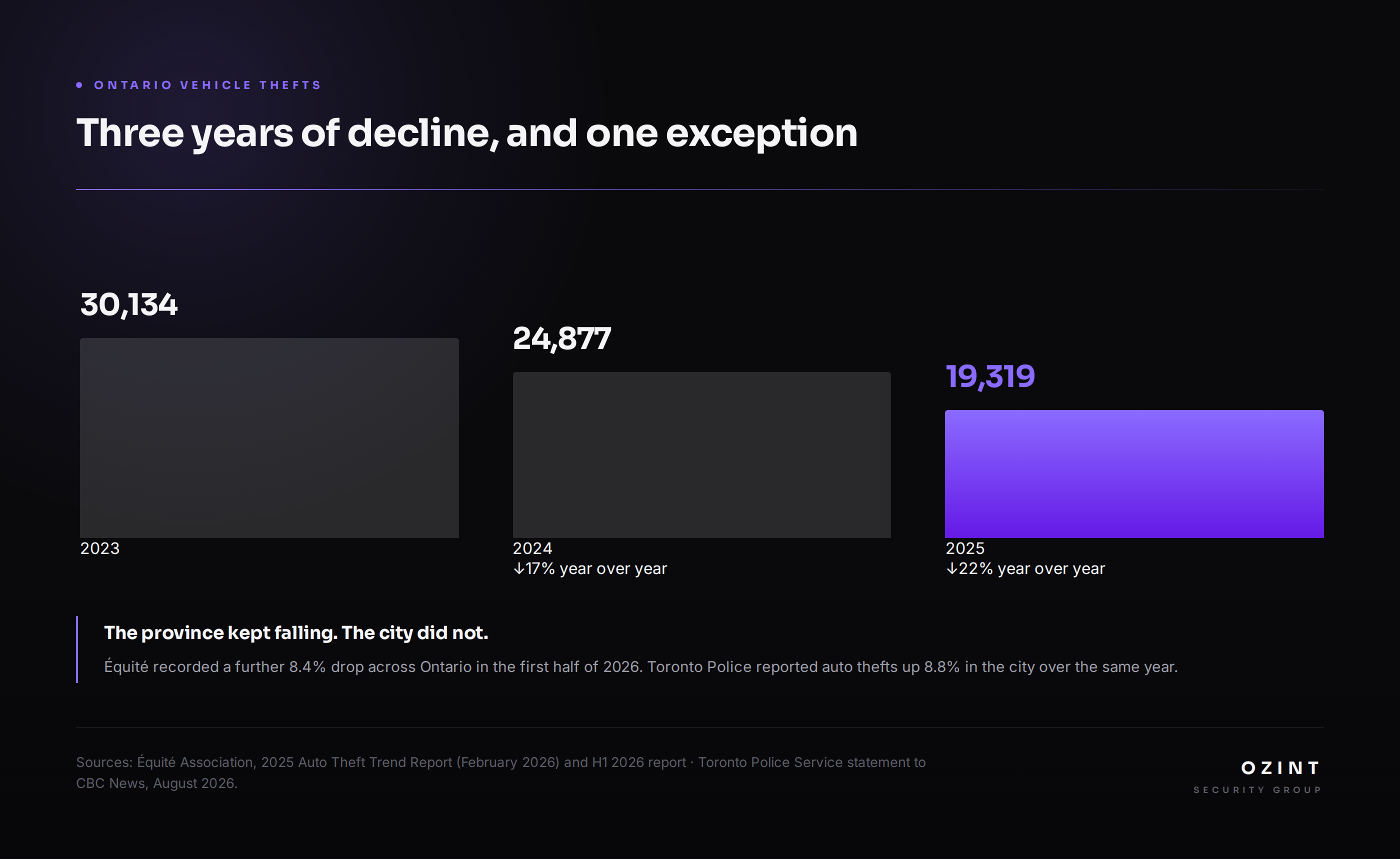
Volume is down. Sophistication is not. As the federal National Action Plan on Combatting Auto Theft has tightened the export routes, Equite's investigators have reported a shift toward chop shops and re-VINed vehicles, which is precisely why recovery has not improved at the same pace as the theft count has fallen. The financial trace is still visible in claims: Ontario auto theft claim costs reached $485 million in 2025, down from $723 million the year before but still far above historical levels, according to the Insurance Bureau of Canada.
A vehicle in a garage is a difficult target. A vehicle on a driveway is an accessible one, and in most Toronto neighbourhoods the second and third vehicles in a household live outside by default.
The pattern is consistent. A vehicle is identified during a first pass, often in daylight, sometimes tagged with a small marker to confirm it has not moved. The theft happens on a later night, usually in the small hours, and takes minutes rather than hours. Nothing about that sequence is random, and nothing in a standard alarm package is watching the driveway while it unfolds.
This is the gap worth understanding. Homeowners tend to secure the house. Vehicle theft happens fifteen feet outside it, in the one part of the property most systems treat as the approach rather than as the target.
Each of these is described here at the level a homeowner needs in order to make a decision. None of it is instructional.
Two people work together. One stands near the house holding a device that picks up and amplifies the signal from a key fob sitting on a hall table or in a kitchen drawer. The second stands at the vehicle, where the relayed signal convinces the car that the key is present. The doors unlock, the engine starts, and the vehicle is driven away.
This is the method most people have heard of, and it is the reason Faraday pouches sell. It is also only one of four.
Modern vehicles run an internal network, the CAN bus, that connects the electronic control units throughout the car. Access to that network is available at a number of exterior points, including headlight and mirror assemblies. A device connected there can send messages that imitate the ones the smart key system would normally send, which unlocks the doors and disables the immobiliser.
The research behind this is public and worth reading. Dr Ken Tindell, chief technology officer of Canis Automotive Labs, reverse engineered one of the commercially sold devices after a colleague's vehicle was stolen, and published a full technical breakdown of how the attack works and how it can be defeated in software.
The important consequence for a homeowner: a Faraday pouch does nothing against this method. The key fob is not involved. If your only countermeasure is signal blocking, you have covered one of four routes into your vehicle.
This method requires physical entry to the cabin first, usually by forcing a door or breaking glass. A diagnostic tool is then connected to the OBD port and used to write a new key to the vehicle.
Canada requires an engine immobiliser on nearly all new light passenger vehicles under Canadian Motor Vehicle Safety Standard 114, administered by Transport Canada. The standard has done real work over two decades, but it was written before this generation of attack tooling existed. That gap is part of what the new harmonised Canada and United States standard for vehicle theft deterrent equipment, developed through UL Standards and Engagement with Equite's participation, is intended to close.
The least discussed method and the most serious one. No electronics, no tooling. Entry to the home, keys taken from wherever they sit, vehicle driven off the driveway.
This is where a vehicle problem becomes a household safety problem, and it is the reason we treat driveway monitoring and residential monitoring as one system rather than two. A home occupied at the time of entry is a different event from a car taken from an empty driveway, and it deserves a different level of protection. If you are weighing providers for the house itself, these are the questions worth asking before you hire anyone.

Read the last column of that comparison. There is no single product on it that closes all four rows. That is the honest answer, and it is the reason the conversation has to move from products to timing.
None of these are bad purchases. They are simply being asked to do a job they were not built for.
On 10 September 2018, the Toronto Police Service moved to a verified response model for burglar alarms. Officers no longer attend an intrusion alarm on the strength of the alarm alone. Response requires verification: real-time audio, real-time video, an eyewitness at the scene including a private security employee, or multiple zone activations. Panic, hold-up and duress alarms were not affected and continue to receive a normal response.
The reason was straightforward. A Toronto Police review found that 97 per cent of burglar alarm calls in 2016 were false.
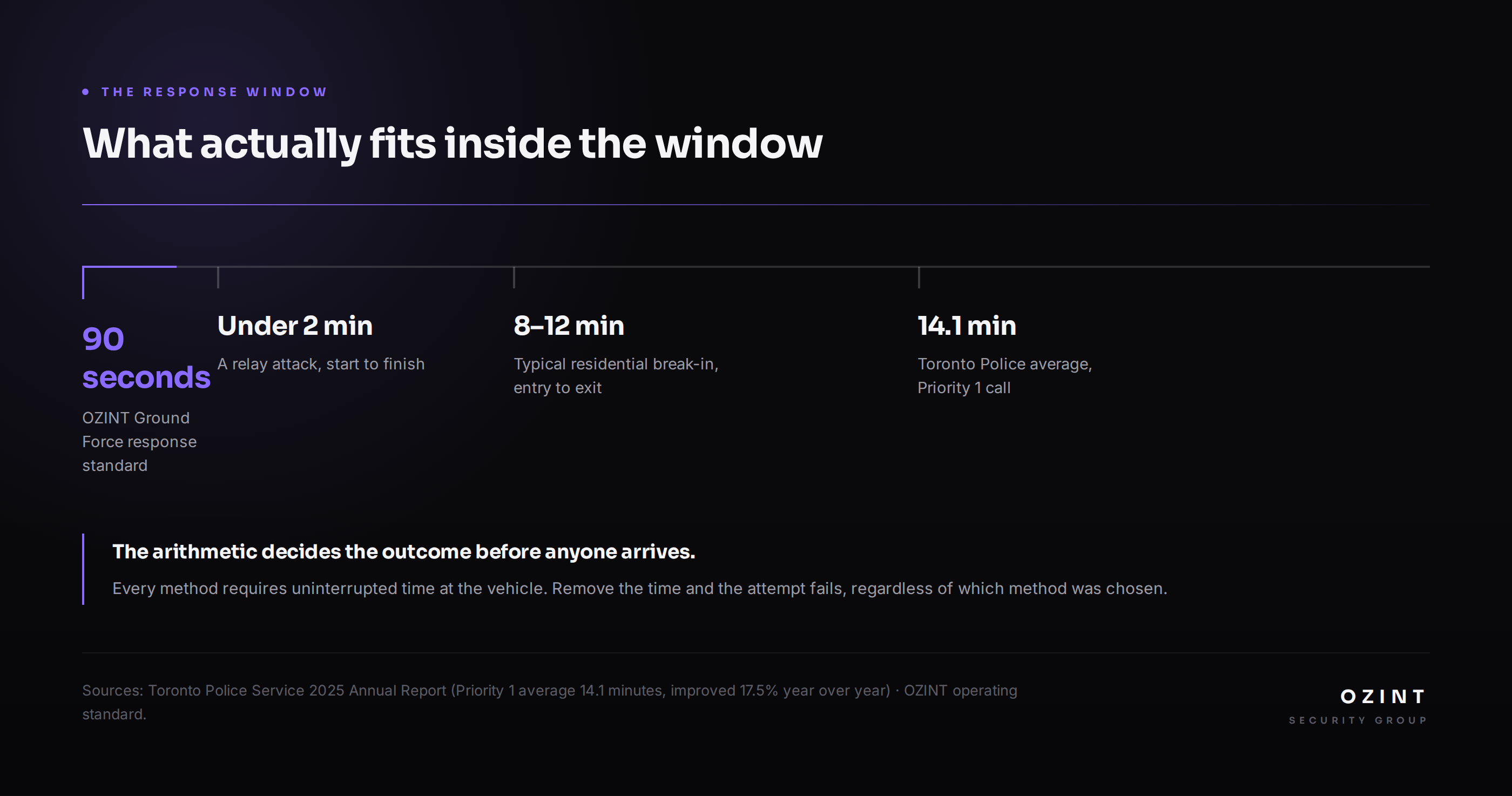
The consequence for anyone with an unverified system is worth stating plainly. An alarm sounding at 3am, with nobody watching a live feed, is a noise. It is not a dispatch. If you are comparing how different providers handle that moment, the three response models are laid out here. And even where a dispatch is triggered, the current Toronto Police Service average response time for a Priority 1 call is 14.1 minutes, improved by 17.5 per cent year over year, with Priority 2 calls averaging 40.0 minutes.
Set that against how long the events above actually take. A relay attack is finished in under two minutes. A residential break-in typically runs eight to twelve minutes from entry to exit. The arithmetic decides the outcome before anyone arrives.
"People ask me why their camera did not stop the theft. A camera does not stop anything. It records. The only question that matters is whether a person is watching that feed while someone is still standing on your driveway, and whether that person can act inside the next ninety seconds. Everything else is a report you read the following morning." - Zohar Haimov, Founder and CEO, OZINT Security Group
Every method described above needs the same thing: uninterrupted time at the vehicle. Remove the time and the attempt fails, regardless of which method was chosen. That is the entire design principle behind Overwatch™, and it resolves into four requirements.
Technology detects. Operators decide. The Command Centre connects the two. A camera alone does none of it.
Car theft in Toronto is continuing to rise across the city, and no vehicle is truly safe without some form of security or protection. From bollards to gates and advanced car alarm systems, thieves are always finding new methods of stealing vehicles.
In this video, we showcase a recent report highlighting the rise and evolution of Toronto car theft and carjackings. It's not just expensive luxury vehicles being stolen, it's your average Toyota or Hyundai that could be at risk too, especially when they are parked outside high-end home in Toronto's elite neighbourhoods.
As mentioned earlier, car theives are not solely focused on targeting high-end luxury vehicles.
Équité Association publishes two rankings each year, and the difference between them is the part that matters if you park something expensive outside. The first ranks by volume, and it is led by ordinary vehicles: the Honda CR-V took the top spot in Ontario with just over 1,300 thefts, followed by the Dodge Ram 1500 and the Honda Civic. The second ranks by theft frequency, meaning the share of insured vehicles of that model actually stolen, and it reads very differently.
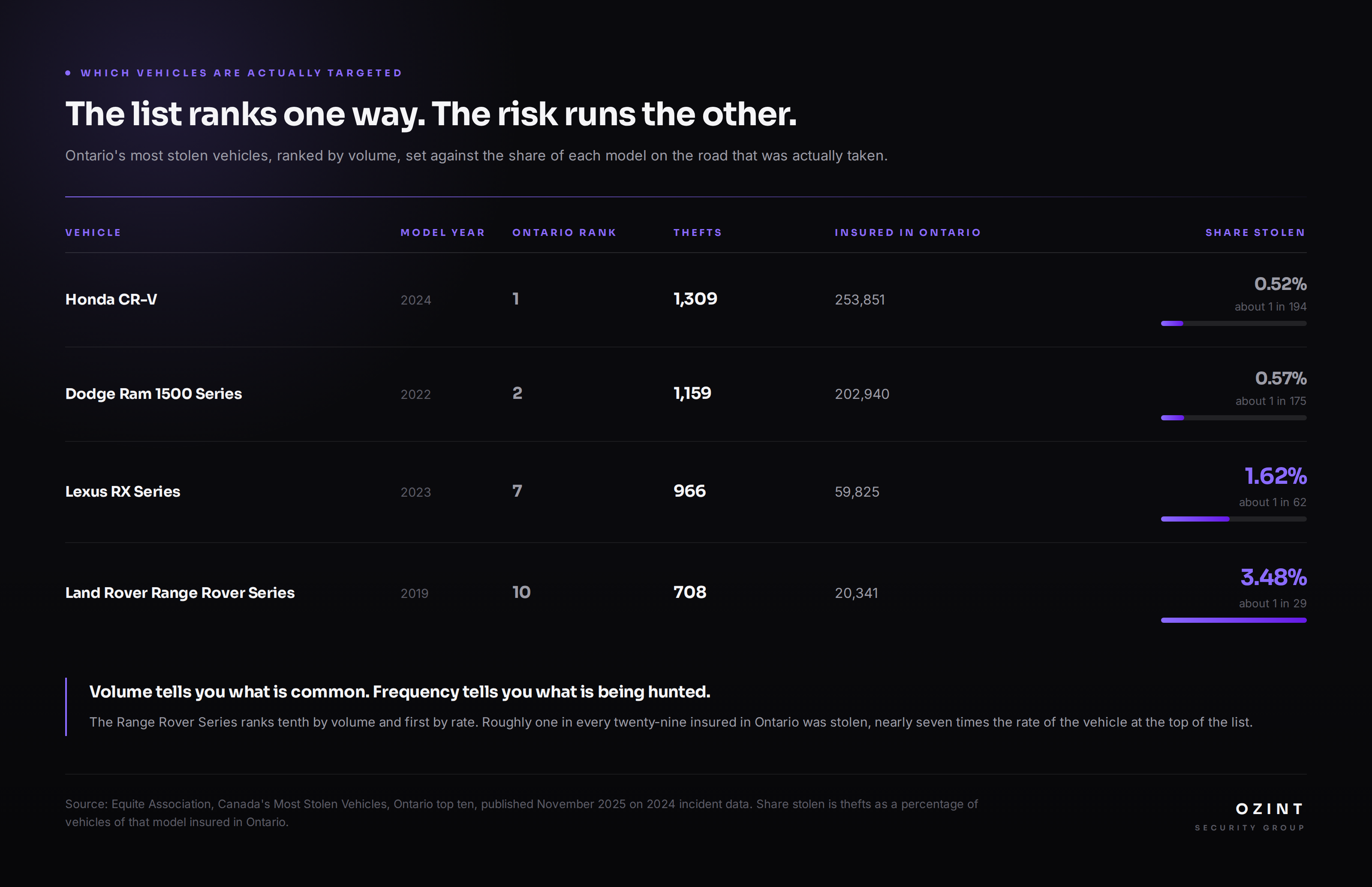
The Land Rover Range Rover Series sits near the top in Ontario at 3.48 per cent, roughly one in every twenty-nine on the road. The Lexus GX Series follows at 2.94 per cent, and nationally the Land Rover Defender and the Mercedes-Benz G-Class both clear 2.7 per cent. The Lexus RX Series appears on both lists, with 966 thefts in Ontario. Volume tells you what is common. Frequency tells you what is being hunted. A Range Rover on a Forest Hill driveway is not competing for attention with the CR-V two streets over, and the odds attached to it are several times higher than the headline numbers suggest.
This is why it's important to understand the theft potential of the car parks outside in your driveway or garage. In the checklist below we share some insightful tips to help homeowners reduce the potential for car theft in Toronto.
Most of what is sold to protect a driveway is a delay device. That is not a criticism. A delay is genuinely useful, because every method of taking a vehicle depends on quiet, uninterrupted time, and anything that adds friction costs the person some of it. The distinction worth holding onto is that a delay only converts into a prevented theft if something happens during it. Physical measures buy the minutes. Detection and response are what use them.
Ranked roughly by how much friction each adds:
Where this leaves you. Stack every item on that list and you have built a property that takes longer to work on. You have not built one where anything intervenes. Nothing above notices a person on the approach, nobody is watching when the bollard turns out to have been left down, and nothing on the list produces the verification that Toronto Police now require before dispatching. That is the gap a monitored system closes and physical hardware cannot.
Analytics tuned to the approach rather than the vehicle, a Command Centre operator watching the feed live, audio and siren triggered on a confirmed person, patrols that interrupt the reconnaissance pass before a target is ever chosen, and Ground Force response units dispatched to a verified event. Physical measures buy time. A properly monitored system with patrol coverage is what turns that time into an interrupted attempt rather than a longer one. The right answer is both, in that order: harden the driveway, then put something on it that is awake.
Most security in this city is built to tell you what happened. A camera records the driveway. An alarm sounds after a door opens. Every one of those steps begins after the vehicle is already gone.
Overwatch works the other way round, in three overlapping layers, each aimed at a different stage of a vehicle theft.
Patrols interrupt the selection. Marked units move through the zone on an irregular pattern. Vehicle theft on affluent streets begins with a first pass, a quiet look, sometimes a marker left on the car. That reconnaissance is the part nothing else is out there to see.
Live monitoring interrupts the approach. Cameras cover the approach path and the street edge, watched in real time by Command Centre operators. When someone crosses the line, the answer is Command Centre audio and an outdoor siren while they are still on the driveway. Most attempts end here, because every method in this article depends on quiet time at the vehicle, and this is the moment that takes it away. Household panic devices run into the same centre.
Ground Force interrupts the attempt. Response units dispatched to a verified event and coordinated with police. Under Toronto's verified response model, live video and a security employee on scene are two of the accepted forms of verification, so our operators are also what allows a police dispatch to happen at all.
Any one layer can be circumvented. That is why there are three.
A high-value SUV on a driveway in Forest Hill, Rosedale or the Bridle Path is not a random target. It is chosen, watched, and returned to. Protecting it takes a system present during all three.
See how Overwatch works, or book a property assessment and we will walk your driveway with you.
Across Ontario, yes. Equite Association recorded a further 8.4 per cent decline in the first half of 2026, following a 22 per cent drop in 2025. Within Toronto specifically, Toronto Police reported auto thefts up 8.8 per cent year to date in August 2026.
No. A Faraday pouch blocks the key fob signal, which defeats a relay attack. It has no effect on CAN injection through an exterior module, on key reprogramming through the OBD port, or on theft of the physical key from inside the home.
Relay attacks have been reported in under two minutes. A CAN injection takes roughly a minute once the device is connected, according to the teardown published by Canis Automotive Labs. Methods requiring entry to the cabin or the house take longer but still finish well inside the current police response window.
SUVs accounted for 46 per cent of all vehicle thefts in Ontario in 2025, the largest share of any vehicle type, according to Equite Association's 2025 Auto Theft Trend Report.
Only if the alarm is verified. Since 10 September 2018, Toronto Police require real-time audio, real-time video, an eyewitness at the scene including private security, or multiple zone activations before dispatching to a burglar alarm. Panic, hold-up and duress alarms are exempt and receive a normal response.
A recorded camera produces evidence after the event. It stops nothing on its own. A camera becomes a preventive tool only when someone is watching the feed live and is able to intervene while the person is still on the property.
Photograph anything unusual before touching it, including marks on the vehicle, disturbed light or mirror housings, and small objects left nearby. Report it to Toronto Police even if nothing was taken, notify your insurer, and move the vehicle to a secured position if you can.
Many Canadian insurers apply a discount for monitored systems, and the size of that discount varies by insurer and by whether the monitoring is certified. Ask your broker what documentation they require, and confirm whether live video verification is treated differently from standard monitoring on your policy.


