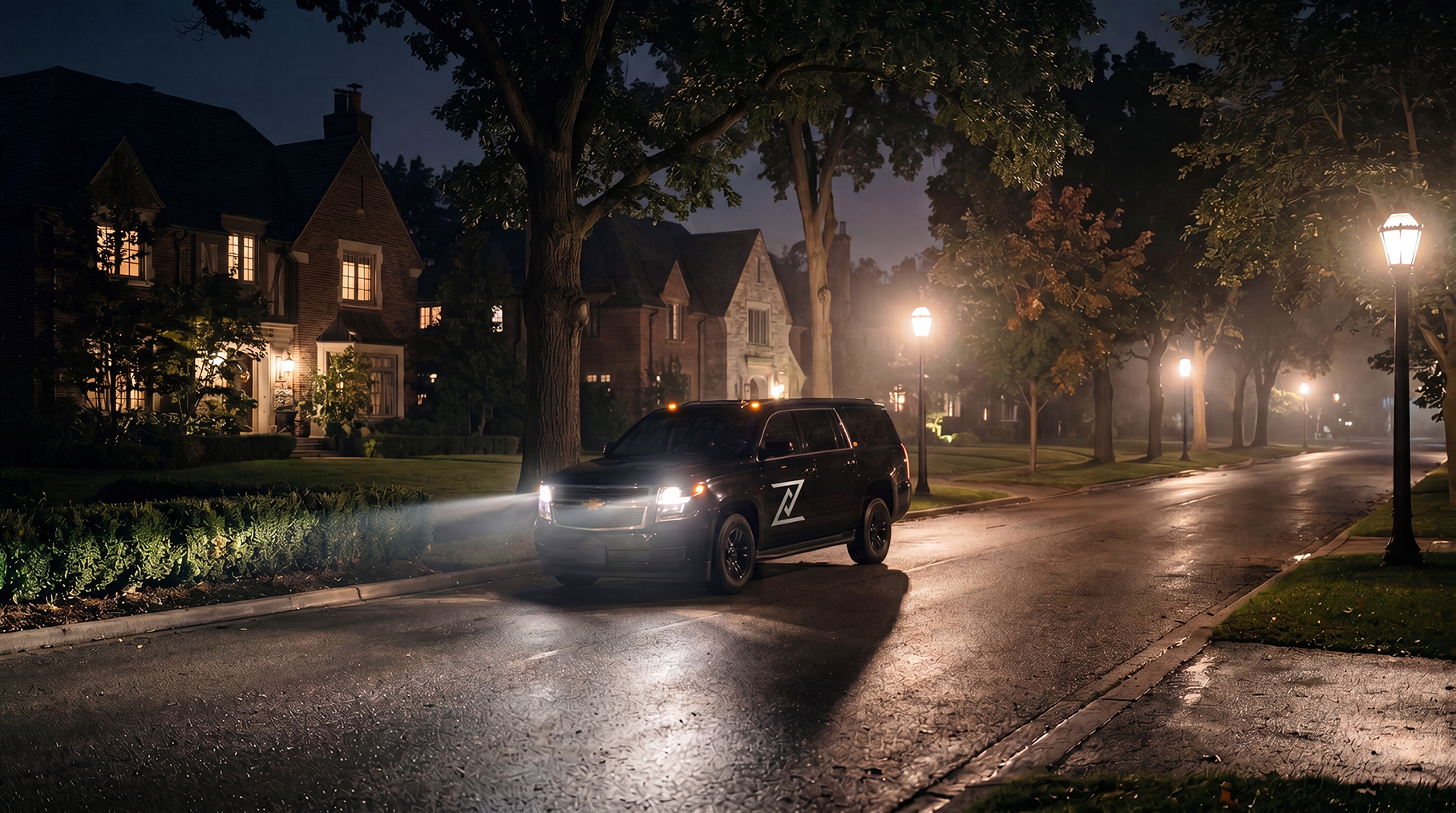
Toronto's safest-looking neighbourhoods are seeing the sharpest rise in organized break-ins. Here's why live patrol is replacing alarm systems in Rosedale, Bridle Path, Forest Hill, and Lawrence Park.
June 24, 2026
Traditional alarm systems react after a breach has already happened. In Toronto's affluent neighbourhoods, where organized crews are specifically targeting high-value homes, that delay is the gap criminals count on. Live patrol with 24/7 SOC oversight closes it. Before hiring any Toronto security company, ask for a verified response time specific to your street, confirmation that guards are direct employees, proof of PSISA licensing, and a clear written breakdown of what is included.
When looking at the key statistics, Toronto had a genuinely good year for public safety in 2025. Homicides fell 47%, from 85 to 45 — a roughly 40-year low. Shootings dropped 43%. Robberies were down 20%. By almost every headline measure, it was one of the safest years the city has had in decades.
But break-and-enter data tells a more specific story once you look at individual neighbourhoods. A Globe and Mail analysis of a full decade of Toronto Police data found that while citywide break-and-enters fell 27% between 2015 and 2025, several of the city's wealthiest communities moved sharply the other way. For example, Rosedale-Moore Park rose 145%, Yonge-St. Clair rose 236%, and Mount Pleasant East rose 233% over that same period.
Organized crews targeting high-value residential properties are methodical about location selection. York Regional Police made 20 arrests in February 2025 in Project Dusk, an operation involving individuals that entered the country with the sole purpose of committing crime for profit. The investigation covered 47 break-and-enters and resulted in 235 charges, with more than $2 million in stolen property recovered. They'll wait, and they'll watch - conducting surveillance before entry to confirm the home is empty.
These operations scale in size and scope but they select targets based on a straightforward risk-reward calculation. Large properties in low-density neighbourhoods score well on every variable.
Below is a list of the top neighborhoods where live patrols are becoming more popular for homeowners.
Some of Canada's most expensive residential real estate sits in this enclave - average home values north of $3.8 million - and the break-in data reflects the attention that attracts. In 2025, Bridle Path–Sunnybrook–York Mills posted a break-in rate of approximately 403 incidents per 100,000 residents across 47 reported incidents, more than double Toronto's citywide average.
The layout is the explanation. Long driveways, heavy perimeter landscaping, and significant setbacks between the street and the front entrance create approach corridors that a fixed camera system, scoped to a defined field of view at the entrance, structurally cannot monitor end to end. Someone on foot along a side property line doesn't appear in most camera angles until they're already on the property. A patrol unit circulating the street does.
The same privacy features that define the neighbourhood's appeal are what make passive surveillance insufficient here.
Rosedale ranked third in Toronto for break-in rate in 2025, despite sitting near the bottom of nearly every other crime category - posting approximately 456 incidents per 100,000 residents across 105 break-and-enters for the year, more than double the citywide average. That pattern, which is low on everything except planned property crime, is the signature of targeted, organized residential theft rather than general neighbourhood disorder.
The decade-long trend is harder to dismiss as a single bad year. The Globe and Mail found a 145% increase in Rosedale break-and-enters between 2015 and 2025, against a 27% citywide decline over the same period. Residents and private security companies are already responding: the same Globe and Mail investigation found private patrol vehicles fanning out after nightfall through the neighbourhood's streets, with unmarked units in bulletproof vests responding to break-ins while security companies pitch what they're calling a "virtual gated community" of camera networks.
Rosedale's specific layout compounds the exposure. Dense, mature tree cover limits sightlines from street to structure. The neighbourhood's irregular street geometry creates corners, mid-block approaches, and rear property access that a camera mounted at a front door or gate doesn't see. Active patrol moving through the area unpredictably covers that ground. Fixed cameras don't.
St. Andrew–Windfields sits in North York and doesn't match the visual profile of Rosedale or the Bridle Path , but the break-in data puts it in the same risk category. In 2025, it recorded approximately 385 incidents per 100,000 residents across 72 break-and-enters, against comparatively low rates across all other major crime indicators. High property values and the specific property type, large detached homes with low violent crime surrounding them, is the common thread with the other communities on this list.
The structural issue here is perimeter complexity. Properties often feature side entrances, rear service lanes, and in some cases ravine-adjacent borders, multiple access points beyond the main driveway, each representing an approach route that a front-of-property camera isn't positioned to monitor. Patrol coverage that moves around a block, rather than watching a fixed angle, closes that gap.
Forest Hill and Lawrence Park share the same structural profile as the higher-ranked areas above: high property values, large lots, mature landscaping, long driveways, and lower pedestrian density per block than the city average. A recent analysis of GTA break-and-enter data notes that affluent neighbourhoods including Forest Hill and Lawrence Park have been consistent targets, even as some citywide categories stabilized in 2025.
The broader pattern across all five areas on this list is consistent: value concentration, limited natural surveillance, and predictable access are the selection criteria. Both Forest Hill and Lawrence Park check every box. For Forest Hill specifically, see how zone-based coverage works on our Forest Hill home security page.
Yonge–St. Clair is the area where the data makes the least intuitive sense — and that's what makes it the most instructive. The Globe and Mail's decade-long analysis found a 236% increase in break-and-enters here between 2015 and 2025 - the steepest rise of any neighbourhood tracked, even as the citywide rate fell 27% over the same period. The adjacent Yonge-Bay corridor recorded approximately 552 break-in incidents per 100,000 residents in 2025, among the highest rates in the city.
The dynamic here differs from the estate neighbourhoods above. Properties are closer together, but elevation changes, mid-block entrances, and the transition between commercial and residential on the same block create uneven surveillance across very short distances. The street looks active. The rear approach doesn't.
Fixed cameras and alarm sensors are detection and documentation tools. In large residential environments specifically, they have structural limitations that no resolution upgrade changes.
A camera covers a defined angle. Mature landscaping in summer reduces that angle. An approach from outside that angle doesn't appear in footage until someone is already on the property, at which point detection has happened but deterrence hasn't. An alarm triggered at a door sensor documents entry; it doesn't interrupt the approach window that preceded it.
Toronto's overall property crime rate runs approximately 40% higher than New York City's, according to the Fraser Institute - even though Toronto ranked 6th globally in the Economist Intelligence Unit's 2024 Safe Cities Index. A city can be statistically safe in aggregate while specific property crime categories concentrate in specific neighbourhoods. For the five areas on this list, that concentration is large enough that detection and documentation alone don't close the gap.
Live patrol operates at the deterrence stage, before entry is attempted, not after it completes. The same Globe and Mail report documented exactly this dynamic in Rosedale, where private patrol vehicles circulating the neighbourhood after nightfall produced a measurable quieting in break-in activity during the period of deployment. A patrol vehicle that a crew watches circle a block twice in 20 minutes changes the risk assessment. A camera that captures their approach after the fact doesn't.
Some property characteristics reliably indicate that static systems won't provide adequate coverage on their own. OZINT's assessment team looks at the following when evaluating whether live patrol is warranted for a specific home:
If several of these apply, the property operates in a higher exposure window than alarms and cameras alone are designed to address. A professional security assessment identifies the specific gaps and whether a patrol deployment closes them.
It needs to be said that the five neighbourhoods on this list aren't unsafe in any general sense. Toronto remains among the safest major cities in the world by aggregate measure. What these areas share is a specific structural vulnerability to organized residential property crime, and organized crews are selecting them precisely because of it.
OZINT's Overwatch program was built around that operational reality. Rather than deploying guards at individual gates, Overwatch operates by focusing on dedicated protection for specific communities, streets and areas: dedicated rapid response units assigned to defined neighbourhood zones, backed by 24/7 Security Operations Center monitoring and panic button integration across all enrolled properties. The result is physical presence across an area rather than at a single address, which is the coverage model that matches today’s evolving threat landscape.
Why do Toronto's wealthiest neighbourhoods have higher break-in rates than the rest of the city?
Organized crews target properties based on value, low foot traffic, and predictable access patterns. Large detached homes in low-density neighbourhoods offer exactly that. The privacy that makes these properties desirable is the same feature that makes them attractive to planned residential theft.
Does Toronto's improving overall crime rate mean affluent neighbourhoods are getting safer?
No. Citywide break-and-enters fell 27 per cent between 2015 and 2025. Over the same period, Rosedale-Moore Park rose 145 per cent and Yonge-St. Clair rose 236 per cent, according to a Globe and Mail analysis of TPS data. Overall averages mask where crime is actually concentrating.
Is residential crime in these neighbourhoods opportunistic or organized?
Increasingly organized. York Regional Police's Project Dusk in February 2025 produced 20 arrests, 235 charges, and $2 million in recovered property from individuals who investigators say entered Canada specifically to commit residential property crime. These are planned operations, not random incidents.
Can better cameras replace live patrol on a large property?
No. Cameras detect and document. They cannot interrupt a crime in progress or cover the blind spots created by multiple access points and mature landscaping. Live patrol introduces unpredictable human presence in the gaps between fixed devices, which cameras alone cannot replicate.
Do I actually need live patrol, or is a monitored alarm system enough?
For most high-value properties in Toronto's affluent neighbourhoods, a monitored alarm alone is not enough. Alarms notify after a perimeter has already been crossed. Live patrol deters before that point and responds before police arrive. If your property has significant landscaping, multiple access points, or sits in an area where break-in rates exceed the city average, patrol is the gap your existing system is not covering.
What does a private security assessment from OZINT involve?
A walkthrough of your property's boundaries, sightlines, and access points using the same evaluation an experienced crew would conduct during reconnaissance. It identifies blind spots, coverage gaps, and weaknesses in existing alarm and camera systems, and produces a clear picture of where live patrol deployment would make the most difference.
Written by the Ozint Security Group Team. OSG provides close protection, residential and neighbourhood security, event security, private investigations, and dedicated patrols for Toronto's premium home and communities.


