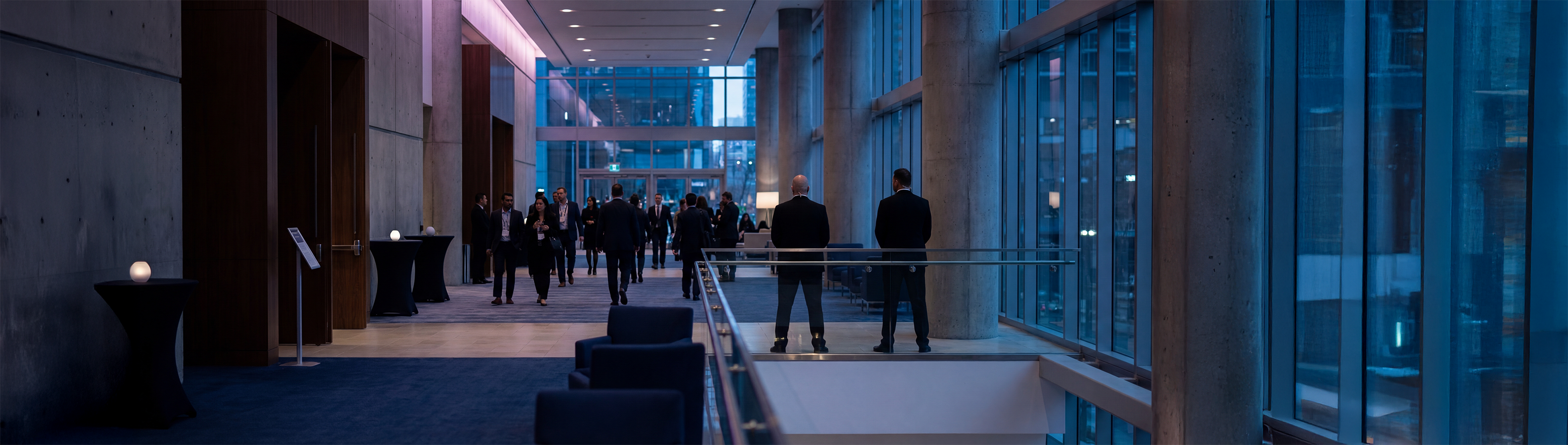
Focus on discreet security, behavioral spotting, layered access control, and intelligence-led planning that protects high-profile events while maintaining atmosphere and guest experience.
November 17, 2025
Event security represents one of the most complex challenges in protective operations. Events bring together large numbers of people, often in high-profile settings, creating both security obligations and experience expectations. The challenge: providing robust protection without creating an atmosphere of oppression, making guests feel like suspects rather than valued attendees, or destroying the event experience through visible, heavy-handed security measures.
The fundamental paradox of event security is that the most effective security is often invisible to those being protected. Highly visible security measures, uniformed guards, metal detectors, invasive searches, create impressions of security but often deliver mediocre actual protection while significantly degrading guest experience.
Meanwhile, truly sophisticated security operations work largely invisibly. Guests experience seamless access, minimal friction, and carefully curated atmosphere. Yet beneath this smooth surface operates comprehensive protection systems: behavioural analysis identifying potential threats, layered access controls preventing unauthorized entry, intelligence-led planning addressing specific risks, and rapid response capabilities for incidents if they occur.
Understanding this paradox is essential for anyone planning high-end events or evaluating event security services. The question isn't "how many security guards will be present?" but rather "how comprehensively will risks be identified and managed while maintaining event quality?"
Professional event security begins weeks before guests arrive, with comprehensive intelligence gathering and risk assessment that informs all subsequent security planning.
Threat Landscape Analysis: Every event occurs within specific threat contexts that must be understood. For a corporate event, threats might include protestors opposed to company policies, competitors seeking proprietary information, or general security concerns about large gatherings. For a private social event, threats might include uninvited guests, paparazzi, or individuals with grievances against the host or guests.
Intelligence gathering identifies specific threats: monitoring social media for organized protest plans, tracking activist groups relevant to event themes or hosts, reviewing recent crime patterns near event venues, assessing geopolitical factors for international guest events, and identifying individuals who might pose threats to specific attendees.
This intelligence informs security planning. If intelligence indicates protest probability, security plans include designated protest areas, communication strategies for engagement, and protocols for maintaining event access despite external disruption. If celebrity attendees attract paparazzi attention, plans address photographer management and private access routes.
Venue Assessment: Comprehensive venue security assessment examines every aspect of the physical environment. Professional security teams conduct site surveys that evaluate: access points and perimeter security, internal layout and sight lines, emergency egress routes, locations for security personnel positioning, technology infrastructure (cameras, communication), proximity to police, fire, and medical services, and vehicle access and parking security.
This assessment identifies vulnerabilities that must be addressed through security measures. A venue with multiple uncontrolled access points requires additional personnel or physical barriers. Poor sight lines necessitate more camera coverage or strategic personnel positioning.
Guest List Analysis: For exclusive events, guest list management is a critical security function. Professional operations conduct background screening appropriate to event sensitivity, verify guest identities against invitation lists, identify VIP attendees requiring enhanced protection, flag any guests with concerning backgrounds, and plan for plus-ones and unexpected additions.
This analysis enables access control personnel to recognize legitimate guests, identify anomalies, and respond appropriately to unauthorized access attempts.
Access control for events operates in layers, with each layer providing additional security filtering while appearing seamless to legitimate guests.
Perimeter Security: The first security layer is venue perimeter control. Before anyone reaches the event, security must establish controlled perimeter with all access points monitored, vehicle access screened and managed, clear distinction between public and event spaces, and perimeter surveillance covering approach routes.
For high-security events, perimeter control might include vehicle checkpoints with credential verification, screening for explosives or weapons, and directed parking that creates stand-off distance from event spaces. For more moderate security needs, perimeter control might simply mean clearly marked access points and personnel observing approach routes.
Credential Verification: As guests arrive at entry points, credential verification confirms authorization. This process should be thorough but not cumbersome. Modern event security uses digital systems that: scan QR codes or RFID credentials instantly, verify against real-time guest databases, flag VIPs for special attention or services, and track attendance for real-time occupancy data.
Well-designed systems verify credentials faster than manual list checking while providing better security and data collection. Guests experience quick, professional entry rather than waiting in lines while staff search paper lists.
Access Tier Management: Many high-end events have multiple access tiers, general admission areas, VIP sections, backstage or restricted zones. Each tier requires appropriate access control: clear physical delineation (barriers, separate entrances), credentials differentiated by tier (different coloured badges, separate credentials), personnel enforcing tier restrictions, and smooth escalation for credential upgrades if authorized.
The key is making tier restrictions feel like exclusive service rather than punitive denial. VIP areas should appear desirable rather than other guests feeling excluded and frustrated.
Continuous Interior Monitoring: Once guests are inside, security doesn't end. Professional operations maintain continuous interior monitoring through: security personnel in civilian clothing circulating through event, cameras covering all event spaces, communication systems connecting all security elements, and behavioural monitoring for unusual activity or developing situations.
This interior security layer responds to incidents that arise during events: medical emergencies, guest conflicts, unauthorized access to restricted areas, or suspicious behaviour indicating potential threats.
One of the most sophisticated aspects of professional event security is behavioural analysis, identifying potential threats based on behaviour rather than obvious indicators.
Baseline Establishment: Professional security personnel quickly establish behavioural baselines for each event, what normal guest behaviour looks like in this setting. People at a corporate conference behave differently than people at a private party, and security must understand appropriate norms for each context.
Once baselines are established, deviations become noticeable. Someone acting unusually within a specific event context draws security attention even if their behaviour wouldn't be concerning in different settings.
Pre-Attack Indicators: Research on attack scenarios identifies common pre-attack behaviours: extended observation of security measures, excessive interest in access points or restricted areas, visible nervousness or stress inconsistent with social gathering, attempts to test security responses, or suspicious bulky clothing or packages.
Security personnel trained in behavioural analysis recognize these indicators and respond appropriately. This might mean enhanced observation, polite engagement to assess intent, or full response if behaviour indicates imminent threat.
Social Engineering Detection: Many unauthorized access attempts use social engineering rather than force, individuals trying to talk their way past access control with convincing stories. They claim to be with the caterer, insist they're guests who forgot credentials, or assert they're venue staff.
Professional access control personnel are trained to recognize social engineering attempts, verify identities through proper channels, and maintain protocols despite convincing narratives.
The art of high-end event security is maintaining robust protection while minimizing visible security apparatus that degrades event atmosphere.
Plainclothes Operations: Security personnel at elite events often work in civilian clothing rather than uniforms. They appear as guests, service staff, or event organizers while conducting security functions. This invisibility serves multiple purposes: reduces security-state atmosphere that makes guests uncomfortable, allows behavioural observation without subjects knowing they're being watched, prevents security measures from becoming event focal points, and maintains elegant aesthetic appropriate for high-end events.
Plainclothes security requires careful training. Personnel must maintain cover while staying connected to security communications, recognize threats while appearing engaged in event activities, and respond to incidents without creating panic among legitimate guests.
Technology Over Personnel: Where possible, technology provides security capabilities with minimal visible presence. Sophisticated camera systems monitored remotely can cover large areas with better consistency than human observation while maintaining cleaner aesthetic. Access control technology processes credentials faster and more reliably than manual verification. Communication systems enable small, well-positioned security teams to coordinate effectively rather than requiring visible security presence everywhere.
Strategic Positioning: Security personnel positioning should be strategic rather than simply visible. Rather than guards standing prominently at every doorway, professional operations position personnel where they can observe multiple areas, respond quickly to any location, and intercept threats before they reach event spaces. This strategic positioning provides better coverage with fewer personnel and reduced visual security impact.
Event security effectiveness depends critically on communication and coordination among all security elements and event staff.
Unified Command Structure: Professional event security establishes clear command structure before events begin. Everyone knows: who has overall security authority, how incidents are reported and escalated, what decision-making protocols apply, and how security coordinates with event management, venue staff, and external services.
Without clear command structure, incidents create confusion about who's in charge and what actions should be taken. This confusion delays response and creates ineffective, uncoordinated security.
Communication Technology: Modern event security uses sophisticated communication systems: radio networks connecting all security personnel, mobile apps for real-time updates and alerts, camera systems feeding to central monitoring stations, and direct links to law enforcement and emergency services.
These systems must be tested before events. Equipment failures during events create critical security gaps.
Stakeholder Coordination: Event security must coordinate with multiple stakeholders: venue security and management teams, catering and service staff who need access to restricted areas, AV and technical crews working throughout event, external services (valet, transportation), and local law enforcement.
Pre-event briefings ensure all parties understand security protocols, access procedures, emergency response plans, and their specific roles in security operations.
Despite best planning, incidents occur at events. Professional security includes pre-planned response protocols for likely scenarios.
Medical Emergencies: Medical emergencies are the most common incidents at events. Security plans should include: medical personnel on-site or rapid access to emergency medical services, clear emergency access routes for ambulances, trained security personnel who can provide initial response, and communication protocols for medical incidents.
Guest Conflicts: Alcohol, social dynamics, and sometimes business rivalries create conflict potential at events. Security response to conflicts should prioritize de-escalation over confrontation, remove conflicting parties from public areas quietly, avoid creating scenes that disrupt other guests, and resolve incidents professionally without excessive force.
Unauthorized Access: When unauthorized individuals are detected inside events, response must: verify unauthorized status, remove individuals discreetly if possible, assess whether incident indicates security system gap, and determine if law enforcement involvement is needed.
The goal is resolving unauthorized access without creating disruption or alarm among legitimate guests.
Serious Threats: For severe incidents—active threats, weapons, violence—security must: activate emergency response immediately, coordinate with law enforcement, initiate evacuation procedures if appropriate, secure VIPs and high-value targets, and maintain communication throughout incident.
Professional security teams drill these scenarios extensively so responses are automatic and coordinated despite crisis pressure.
OZINT Security provides event security for Toronto's most prestigious gatherings, corporate events, private celebrations, and high-profile social occasions where security must be robust but invisible.
Our approach begins with comprehensive pre-event intelligence and planning. We assess specific threats relevant to each event, conduct detailed venue security surveys, develop customized security plans addressing identified risks, and coordinate with all stakeholders before event day.
Our security personnel for events include Israeli-trained operatives with extensive experience in high-threat environments. They understand behavioural analysis, can detect threats in complex social settings, maintain professional demeanour under pressure, and respond to incidents with appropriate force and judgment.
Technology integration distinguishes our event security. We deploy temporary camera systems monitored by our Security Operations Center, use advanced access control technology for seamless guest processing, maintain real-time communication with all security elements, and integrate digital credentialing that speeds entry while improving security.
Most importantly, we understand that event security success is measured not just by prevented threats but by guest experience. Our clients tell us frequently that their guests remarked how smooth and seamless the event felt, never realizing the comprehensive security operation running invisibly to protect them.
Consider a recent event OZINT secured: a charity gala at a Toronto venue with 400 guests, including prominent business leaders, celebrities, and politicians. The event combined significant security challenges with demanding experience expectations.
Pre-event intelligence identified potential protest activity by activist group opposed to one corporate sponsor. We coordinated with Toronto Police to establish designated protest area allowing free speech while maintaining event access. Additional security monitored protest area for escalation risks.
Venue assessment revealed multiple public access points requiring control and limited sight lines in certain areas necessitating additional camera coverage. We established perimeter control with discrete security checking credentials at controlled access points, closing unneeded access points with temporary barriers, and monitoring all approach routes via temporary camera systems.
Guest credentialing used mobile app-based digital invitations with QR codes. Guests presented codes at entry for instant verification. VIPs received expedited entry through separate, premium access point with dedicated concierge service. Total processing time from arrival to inside venue averaged under 45 seconds per guest, faster than traditional list-checking while providing better security.
Inside the event, eight plainclothes security personnel circulated through guest areas providing behavioural monitoring. They appeared as guests or event staff while maintaining communication with our command centre and ready to respond to incidents.
The protest materialized with about 30 participants but remained peaceful in designated area. Our security liaison engaged protest organizers, established respectful boundaries, and maintained open communication. Protest proceeded without incident and guests entered event without disruption.
One medical incident occurred when elderly guest experienced cardiac event. Our on-site medical team responded immediately while plainclothes security cleared emergency access route. Paramedics arrived, accessed event without delay, and transported patient to hospital. Event management made brief announcement asking for prayers, but incident was handled so professionally that most guests remained unaware of severity.
Post-event feedback from host and guests was overwhelmingly positive: guests commented on smooth entry and professional staff, host specifically noted how invisible security was despite comprehensive protection, and media coverage focused on event purpose with no mention of protests or security.
This outcome, comprehensive protection delivered invisibly, represents professional event security at its best.
Event security done poorly creates oppressive atmosphere where guests feel suspected, processes create friction and delays, and visible security apparatus becomes event focal point competing with intended purpose.
Event security done professionally enhances guest experience by providing safety that allows relaxed enjoyment, smooth processes that facilitate rather than impede, and atmosphere matching event purpose and tone.
For Toronto clients planning high-profile events, OZINT Security provides event security that protects without oppressing, secures without creating scenes, and operates invisibly while remaining comprehensively effective. Our Israeli-trained personnel understand how to assess threats, detect concerning behaviour, and respond to incidents while maintaining discretion and professionalism appropriate for Toronto's most prestigious occasions.
Because in event security, success isn't measured by how many people you stop, it's measured by how safe guests feel and how seamlessly security enables the event experience.


