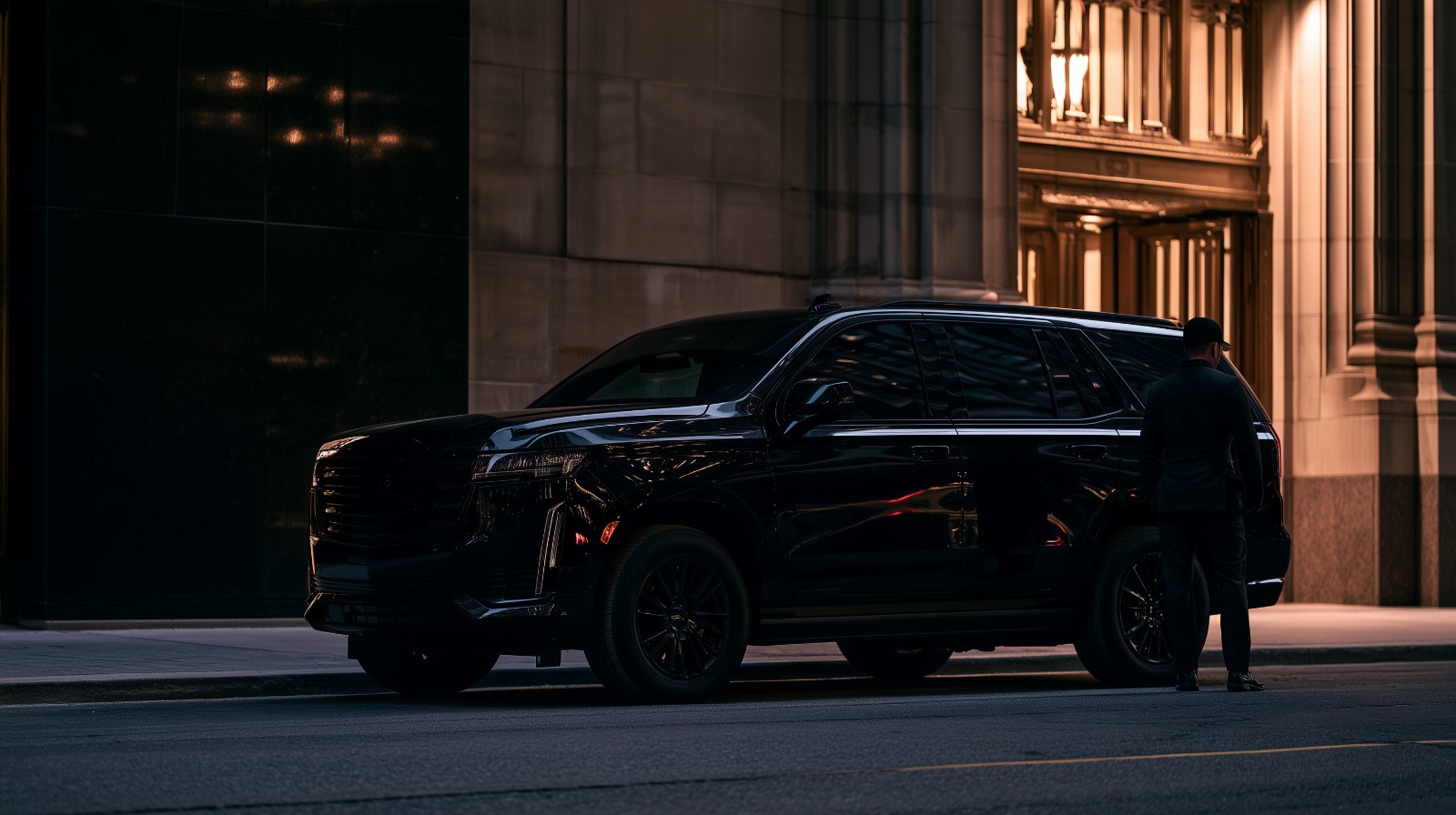
A practical guide to armoured transport in Toronto: who it's for, protection levels, consideration factors, and how to evaluate a provider.
September 14, 2026
Armoured vehicle transport in Toronto is a protected ground movement service: a ballistically rated vehicle, a trained protective driver, a route planned in advance, and a coordinated arrival. It is used by executives, family offices, jewellers, auction houses, and visiting delegations across Toronto and the GTA. It is not a limousine with tinted windows, and it is not reserved for heads of state.
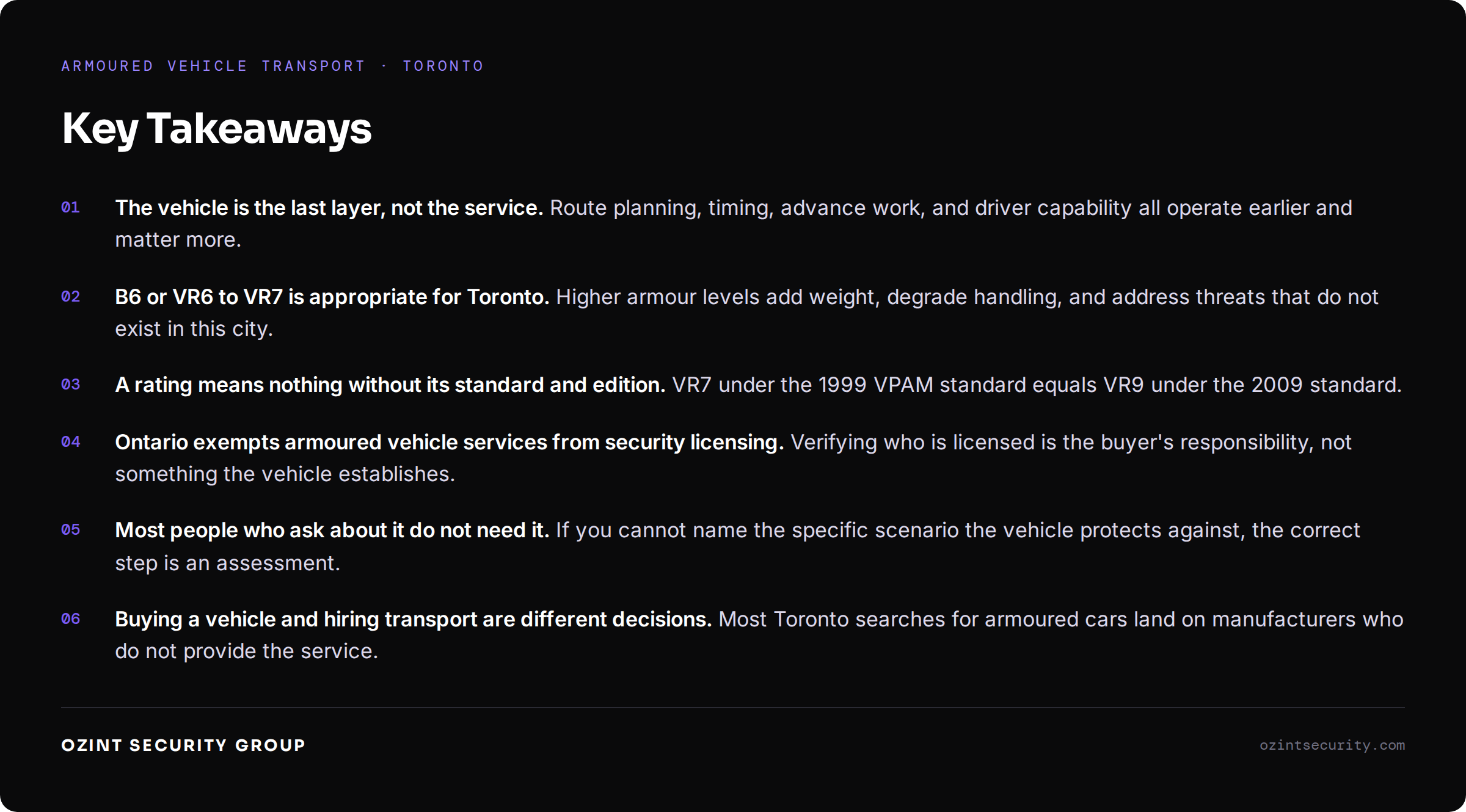
A walkthrough of an armoured vehicle configured for protected transport in Toronto, covering what the protection level actually means, why discretion matters more than armour, and how the vehicle fits into a wider movement plan.
Armoured vehicle transport is the movement of a person or high value property in a vehicle built to resist ballistic and forced-entry attack, operated by personnel trained in protective driving and route security, with the route planned in advance and the movement monitored throughout.
The vehicle is one component. The service is the whole system: what happens before the vehicle arrives, how the route is chosen, how the arrival and departure points are managed, and what the driver does in the first three seconds of a problem.
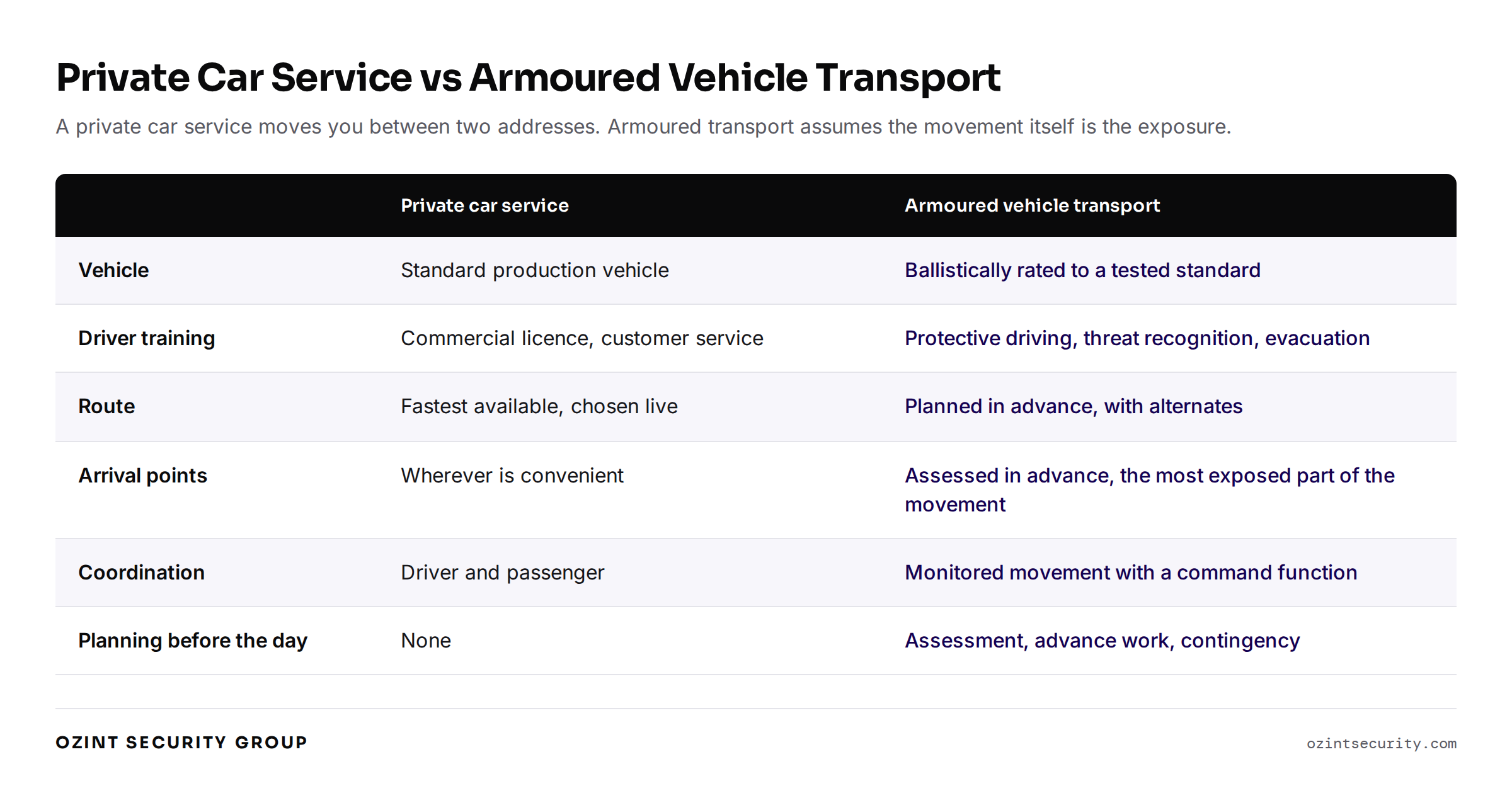
A private car service moves you from one address to another. Armoured transport assumes the movement itself is the exposure and plans around it.
They are regulated differently and should not be confused.
Protected passenger transport. Moving people. The vehicle is usually a discreet SUV or sedan that looks identical to its factory version. The objective is that nothing about the movement draws attention.
Valuables in transit. Moving cash, bullion, gemstones, or high value goods. Different vehicles, different protocols, different legal framework.
Four groups account for most legitimate demand in this city.
Business owners, founders, and senior executives whose name and face are publicly attached to a company. The exposure is not constant. It concentrates around specific events: a contentious negotiation, a termination, a public filing, a court appearance, an airport transfer at an hour when the airport is empty.
The pattern that matters here is predictability. A principal who leaves the same address at the same time and takes the same route to the same Bay Street office five days a week has published a schedule without meaning to. This is the same exposure our corporate and executive protection programmes are built to address on foot and on site.
Family offices use protected transport in defined windows rather than as a standing arrangement. Common triggers: moving family members during a relocation, covering a household through a divorce or a business sale, transporting valuables during a renovation, or managing travel for a principal who has received unwanted contact.
Toronto's jewellery sector has had a difficult period. Toronto Police Service told Global News that 43 jewellery store robberies had been reported in 2024, compared with 21 during the same period the previous year, an increase of roughly 105 percent.
The relevant detail for transport is where these incidents happen. In May 2026, Toronto police reported that four masked men approached a parked vehicle near Spadina Avenue and Bremner Boulevard just before 5 a.m., held the occupants at gunpoint, and took jewellery later appraised at more than one million dollars. The target was a vehicle, not a store.
People who do not live here, do not know the city, and are working from a published schedule. Corporate delegations, visiting family office principals, touring artists, and inbound executives all fall into this group. They are exposed precisely because they are unfamiliar with the ground.
Most people who ask about it. This is worth saying plainly.
If there is no specific threat, no public profile, no high value cargo, and no unusual movement pattern, an armoured vehicle solves a problem that does not exist. A reputable provider will tell you that in the first conversation.
Residential exposure is a different problem with a different answer. If the concern is your home rather than your movement, neighbourhood residential protection addresses it directly and at a fraction of the cost.
The honest test: can you name the specific scenario the vehicle is protecting against? If the answer is a general sense of unease rather than a scenario, the correct recommendation is an assessment, not a vehicle.
Because the vehicle became the point of exposure.
Toronto's auto theft numbers have fallen sharply from their peak. Toronto Police Service reported 12,592 auto thefts in 2023, the worst year on record, dropping to 9,664 in 2024 and 7,305 in 2025. TPS stated in 2026 that auto thefts had declined 32.2 percent by the end of 2025, though they had risen slightly by 8.8 percent so far in the current year. Provincially, Equite Association recorded 8,796 private passenger vehicles stolen in Ontario in the first six months of 2026, an 8.4 percent decrease year over year.
Volume is down. That is the good news, and it should be stated first.
What has not resolved is the character of the incidents. The Toronto Police Service's Provincial Carjacking Joint Task Force describes auto crimes that increasingly involve violence, firearms, and other weapons, noting more than 300 carjackings across the GTA in 2023 with over 200 of those in Toronto.
The locations matter more than the totals. In April 2026, Toronto police reported a series of carjackings that included a vehicle taken from a driveway near Lawrence Avenue West and Avenue Road at approximately 11 a.m., and a victim approached while sitting in her car near Bayview Avenue and Hillsdale Avenue East at approximately 9 a.m. Residential streets. Established neighbourhoods. Business hours.
Fewer incidents. Different incidents. Those two facts are not in conflict, and the second is the one that drives demand for protected transport.
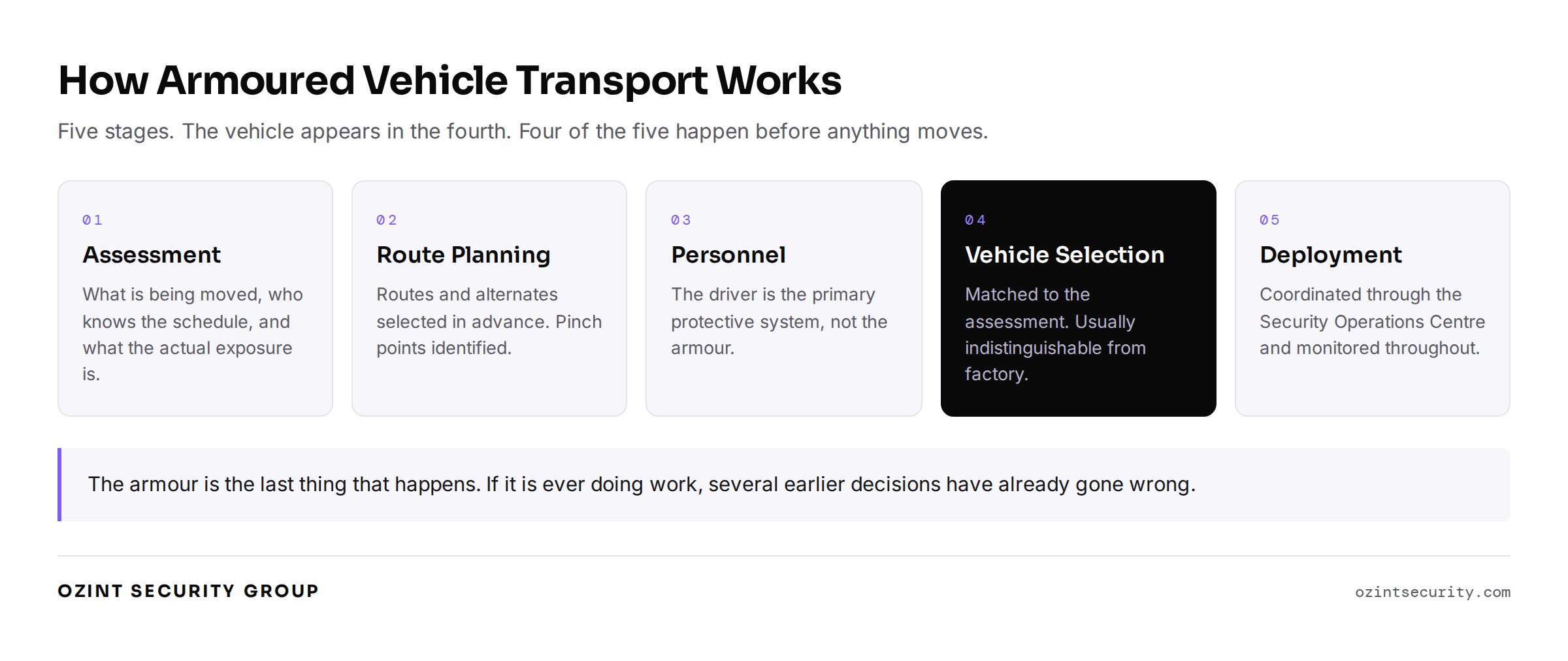
The engagement starts with an assessment, not a quote. What is being moved, who knows the schedule, what does the movement pattern look like, what has already happened, and what is the actual exposure. Most of what shapes the plan comes out of this conversation.
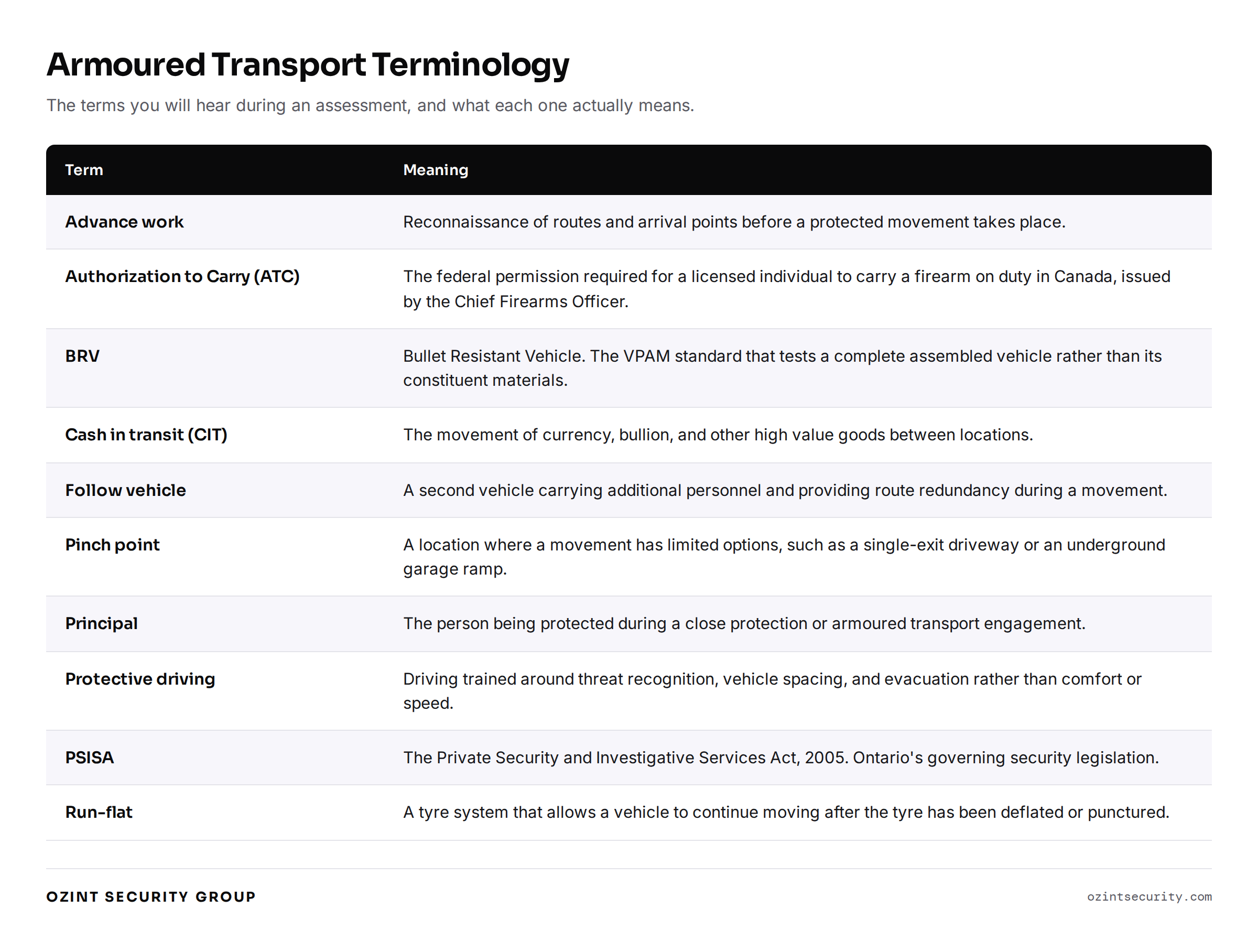
Routes are selected in advance with alternates. Pinch points are identified: underground garages, single-exit driveways, valet stands, loading docks, the fifteen metres between a door and a vehicle.
In Toronto specifically, that means understanding where the 401, the Gardiner, and the DVP become single points of failure, and what the alternate looks like when one closes. It means knowing which downtown hotel entrances put a principal on an open sidewalk and which do not.
Arrival and departure points receive the most attention, because that is where the exposure concentrates. The May 2026 Spadina and Bremner incident, and the April 2026 driveway carjackings, all occurred at the transition between vehicle and destination. That is the pattern.
The driver is the primary protective system. Not the armour. Protective driving is a trained discipline: managing following distance so the vehicle is never boxed in, reading the environment continuously, recognising a developing situation early enough that the response is a route change rather than an emergency.
Depending on the assessment, an engagement may include a protective operator in addition to the driver, and advance personnel who clear arrival points ahead of the movement.
Matched to the assessment. For most Toronto engagements the correct vehicle is one that looks like every other vehicle on the road. Discretion is a protective measure. A vehicle that announces itself has told an observer exactly which one matters.
Movements are coordinated through OZINT's Security Operations Centre. Position is monitored, deviations are visible in real time, and there is a defined escalation path if something changes mid-route. A vehicle operating with no one watching it is a vehicle with no support.
People think the armour is the security. The armour is the last thing that happens, and if it ever gets used, several earlier decisions have already gone wrong. The work is in the route, the timing, and the driver. The vehicle is what is left when all of that fails. - Zohar Haimov, Founder and CEO, OZINT Security Group
Cost is driven by the assessment, not by a rate card. Six factors account for most of the variance.
This is the section most providers do not publish, and it contains a gap worth knowing about.
Under Ontario's regulations made under the Private Security and Investigative Services Act, 2005, the Ministry of the Solicitor General lists categories of individuals who do not require a licence. That list includes, in the ministry's own wording, people who are paid for work that provides an armoured vehicle service.
Read that carefully. Operating an armoured vehicle service in Ontario does not, by itself, require a security licence from the province.
This is not a loophole anyone is exploiting improperly. It exists because the armoured car industry developed under separate commercial arrangements. But the practical consequence matters to anyone buying the service: the presence of an armoured vehicle tells you nothing about whether the people in it are licensed, trained, vetted, or accountable to any regulator.
Verifying licensing is therefore the buyer's responsibility, not something the vehicle establishes.
Where an engagement involves protective personnel rather than only a vehicle and driver, those individuals must hold individual licences under the Private Security and Investigative Services Act, 2005. Licences have been digital-only in Ontario since September 30, 2023. Licensed personnel must carry a hard copy or digital version at all times on duty and produce it on request, including to a member of the public.
That last point is usable. You can ask, and they must show you.
Ontario regulates what licensed personnel may carry. Per the Ministry of the Solicitor General, security personnel may carry equipment issued by their employer, including a baton used only for defensive purposes, and handcuffs.
Carrying a firearm requires more. It requires a valid firearms licence and an Authorization to Carry issued by the federal government. On duty, personnel must carry and present both on request, as required by the Firearms Act and the Authorizations to Carry Restricted Firearms and Certain Handgun Regulations. The Authorization to Carry is issued by the Chief Firearms Officer and is granted narrowly. It is not a general permission and it is not attached to a security licence.
The overwhelming majority of protected passenger transport in Toronto involves no firearm at all. Any provider presenting armed personnel as a standard inclusion has told you something about how carefully they read the regulations.
Ontario normally requires licensed security personnel to wear a uniform displaying the word "security" prominently. There are defined exceptions, including for personnel hired as a bodyguard and for plain clothes assignments. Licensed personnel working under an exception still carry and produce their licence on request.
This is the regulatory basis for discreet protective transport. The discretion is provided for in the rules, not worked around them.
Ten questions. The answers are more informative than any brochure.
Coverage spans Toronto and the Greater Toronto Area, with inter-city and cross-border movements available where the engagement requires it.
Toronto: Downtown and the Financial District, Yorkville, Forest Hill, Rosedale, Lawrence Park, York Mills, The Bridle Path, Summerhill, North York, Etobicoke, and Scarborough.
Greater Toronto Area: Mississauga, Vaughan, Markham, Richmond Hill, Oakville, Burlington, and Aurora.
Airports and transport hubs: Toronto Pearson International Airport, Billy Bishop Toronto City Airport, and Union Station, including private terminal and fixed-base operator arrivals.
Route planning covers the major corridors, including Highway 401, the Gardiner Expressway, the Don Valley Parkway, Highway 427, and Highway 407, with alternates planned for each.
It is the movement of a person or high value property in a ballistically rated vehicle operated by trained protective personnel, with the route planned in advance and the movement coordinated throughout.
No. Most clients are business owners, family offices, and companies moving high value goods. The determining factor is whether a specific exposure exists, not public profile.
Cost depends on duration, personnel count, vehicle specification, advance work required, geography, and notice period. A single airport transfer and an ongoing executive programme are not comparable. Any provider quoting a price before conducting an assessment is quoting a package, not a plan.
Yes. Civilian armoured passenger vehicles are legal in Canada, and Ontario is a manufacturing centre for them. Firearms carried by personnel are regulated separately and require federal authorization.
Not necessarily. Ontario's regulations exempt people paid for work that provides an armoured vehicle service from the requirement to hold a Ministry of the Solicitor General licence. Protective personnel on an engagement do require individual licences. Verify licensing directly rather than assuming it.
For the threat profile in this city, B6 or VR6 to VR7 is generally appropriate. Higher levels add weight and degrade vehicle handling without addressing a threat that exists here.
CEN tests materials and glazing. VPAM tests the complete assembled vehicle, concentrating fire on identified weak points, and requires zero penetrations to pass. Both are legitimate. They are not equivalent.
Buying suits daily, sustained, long-term exposure and requires you to recruit a trained driver, arrange specialist maintenance, and handle insurance. Hiring suits defined windows and variable need, and includes the driver, route planning, and monitoring. Most Toronto exposure profiles are episodic, which favours hiring.
Yes. Single movements are common: an airport transfer, a court appearance, an event, a one-time transport of valuables. Ongoing programmes are also available where the assessment supports one.
Enough time for an assessment and advance work, which usually means several days. Shorter timelines can be accommodated, though the planning depth is reduced accordingly, and that trade should be stated openly rather than hidden.
No, though they overlap. Armoured transport protects a movement. Close protection covers a person across all settings, including on foot, at venues, and at residences. Many engagements use both.
The majority of protected passenger transport in Toronto involves no firearm. Where an engagement genuinely warrants it, any armed personnel must hold both a valid firearms licence and a federal Authorization to Carry, which is granted narrowly and is not a standard inclusion.
Toronto and the Greater Toronto Area, including Mississauga, Vaughan, Markham, Richmond Hill, Oakville, Burlington, and Aurora, plus Pearson International and Billy Bishop airports. Inter-city and cross-border movements are available where the engagement requires it.
A confidential conversation covering what is being moved, the schedule, who has visibility of it, the movement pattern, and any history. It determines the plan, and it frequently concludes that a vehicle is not what is required.
You can book an armoured vehicle to securely transport yourself, executives, family members, event guests and more through OZINT Security Group. If you would like to contact the OZINT team to book, you can book your armoured transport vechile here.


