An in-depth exploration of how artificial intelligence and human expertise complement each other in modern security operations, highlighting the irreplaceable value of trained operators alongside cutting-edge technology.
November 17, 2025
The security industry stands at a fascinating crossroads. On one side, artificial intelligence and advanced technology promise unprecedented capabilities for threat detection, pattern recognition, and automated response. Marketing materials with AI systems that never sleep, never miss a detail, and process information faster than any human possibly could. On the other side, experienced security professionals emphasize judgment, intuition, and contextual understanding that only comes from years of operational experience.
The reality, as with most seemingly binary choices, is more nuanced and more interesting than either extreme suggests.
Artificial intelligence has made genuine, impressive advances in security applications. Modern AI systems can analyze video feeds from dozens of cameras simultaneously, identifying unusual patterns of movement, recognizing faces, detecting abandoned objects, and flagging behaviours that might indicate threats. Machine learning algorithms process vast amounts of data to identify correlations and patterns that would be impossible for human analysts to detect manually. Predictive analytics assess risk levels for different locations, times, and circumstances with remarkable accuracy.
These capabilities are not theoretical. They're being deployed in security operations worldwide with measurable results. AI-driven video analytics can monitor parking lots for suspicious loitering behaviour, track vehicles entering and exiting secure areas, and identify individuals on watchlists from crowds. Behavioural analysis algorithms detect anomalies in access patterns that might indicate insider threats or compromised credentials. Threat intelligence platforms aggregate information from thousands of sources, using natural language processing to identify relevant threats and present them to security analysts.
Yet despite these capabilities, technology-only security solutions consistently fail in real-world operations. The failure isn't due to technical limitations of the AI itself but to the fundamental nature of security decision-making, which requires contextual understanding, judgment about ambiguous situations, and nuanced human interaction that current AI cannot replicate.
To understand where AI adds value, we must first recognize what it genuinely does better than humans. AI's advantages cluster around processing speed, consistency, and pattern detection in large datasets.
Consider video surveillance monitoring. A human operator watching multiple camera feeds inevitably experiences attention fatigue. Research on vigilance tasks shows that human attention degrades significantly after about 20 minutes of sustained monitoring, and performance continues to decline over longer shifts. An operator might miss a suspicious individual precisely because that individual appears on camera 37 during hour six of an eight-hour shift when human attention is at its lowest.
AI systems don't experience attention fatigue. They monitor continuously with consistent vigilance, applying the same analytical standards to every frame they process. If programmed to flag individuals loitering in specific areas for more than 10 minutes, the system will reliably identify every instance regardless of when it occurs or how many other events are happening simultaneously.
Pattern recognition in large datasets represents another area where AI significantly outperforms human capability. Consider a corporate security team trying to identify insider threat indicators across thousands of employees. They might look for unusual access patterns: employees accessing files outside their normal responsibilities, working hours that deviate from established patterns, or access attempts to sensitive systems that don't align with job functions.
Manually analyzing access logs for thousands of employees would require enormous human resources and would still likely miss subtle patterns. AI systems can analyze these datasets continuously, identifying anomalies and flagging them for human review.
Facial recognition technology, when properly implemented and calibrated, can match faces against watchlists with impressive speed and accuracy. A trained human might be excellent at recognizing familiar faces, but asking security personnel to mentally compare every individual they encounter against a database of thousands of potential threats is unrealistic. AI facial recognition systems can perform these comparisons instantaneously, alerting operators when individuals of concern appear.
While AI processes data faster than humans, security operations require capabilities that current technology simply cannot replicate. The most critical of these is contextual understanding: the ability to interpret situations based on subtle cues, environmental factors, and experience-based pattern recognition that goes beyond explicit programming.
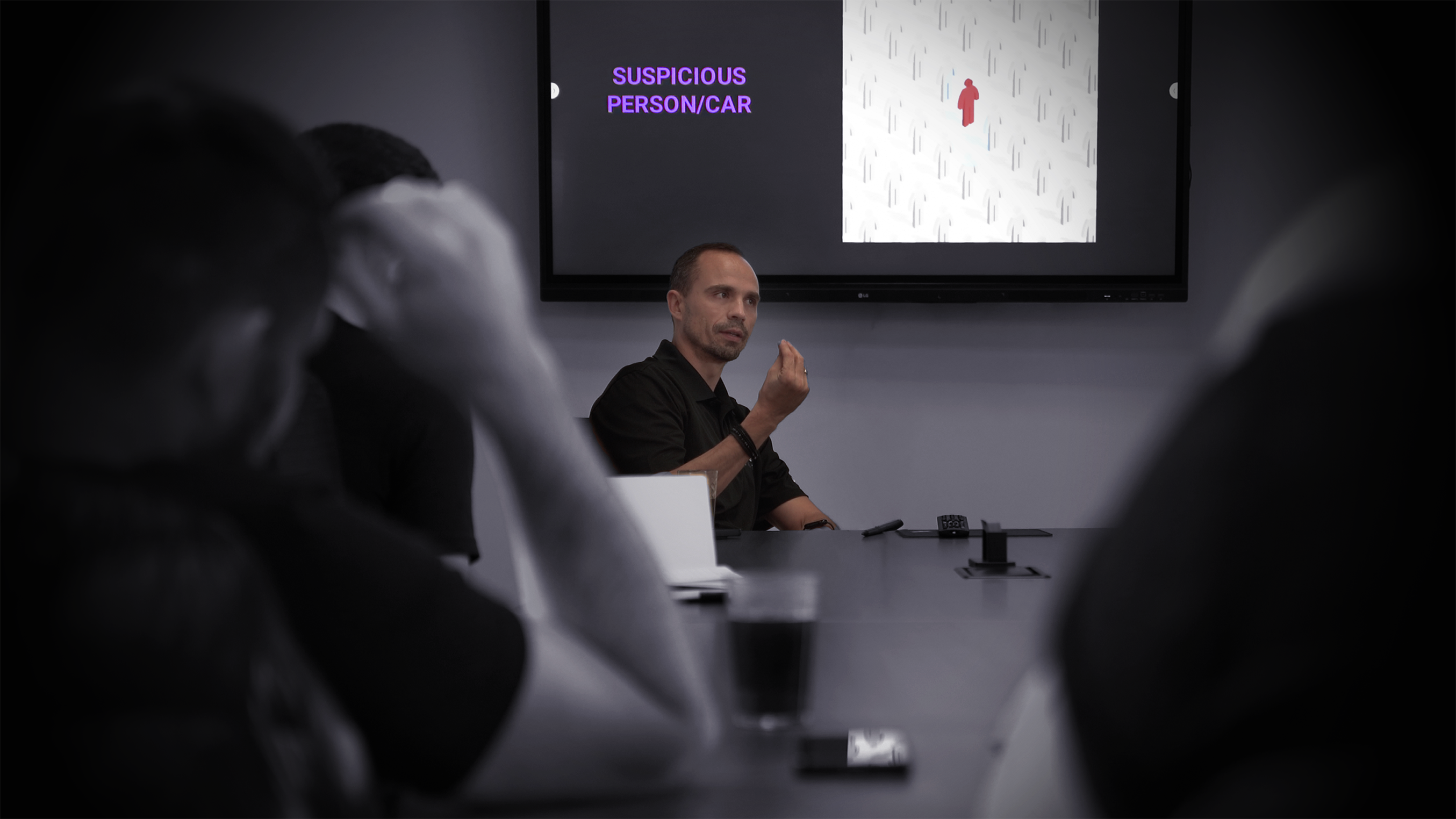
Consider a scenario from an upscale Toronto neighbourhood. An AI system monitoring residential CCTV might flag an individual walking slowly down the street, pausing occasionally to look at houses. The behaviour matches parameters programmed for potential residential reconnaissance: slow movement, repeated stopping, apparent examination of properties. The system generates an alert for human operators.
An inexperienced operator reviewing the alert might immediately dispatch security to investigate, potentially leading to an embarrassing confrontation with a real estate agent previewing properties for a client. An experienced security professional recognizes additional context: it's mid-afternoon on a weekday, the individual is professionally dressed, carrying a portfolio or tablet, and is openly examining properties rather than trying to avoid detection. The behaviour isn't suspicious reconnaissance but normal professional activity.
This example illustrates the critical difference between pattern matching and judgment. The AI correctly identified a behaviour pattern that matched its programming. The human operator applied contextual understanding to correctly assess the situation, avoiding unnecessary response while maintaining appropriate vigilance.
Experienced security professionals develop what often appears as intuition but is actually sophisticated pattern recognition built through years of operational experience. This capability manifests in behavioural analysis: the ability to read body language, detect deception, identify pre-attack indicators, and assess intent rather than simply observing actions.
A trained protective security officer recognizes when someone's movements through a space don't match their stated purpose. If someone claims to be shopping but their eyes are focused on security cameras, exits, and staff positions rather than merchandise, that disconnect signals potential hostile reconnaissance. An AI system might track the individual's movement pattern, but it cannot read the subtle difference between genuine shopping behaviour and surveillance behaviour.
Interview and interaction capabilities represent another domain where human judgment remains irreplaceable. When a security officer engages with someone to determine their purpose in an area, they assess not just the content of responses but delivery, consistency, emotional cues, and dozens of micro-expressions and behavioural indicators that signal truthfulness or deception. These assessments happen rapidly and often subconsciously, drawing on pattern libraries built through thousands of previous interactions.
Current AI cannot replicate this capability. While researchers develop emotion recognition algorithms and systems that attempt to detect deception through voice stress analysis or facial micro-expressions, these technologies remain far less reliable than experienced human judgment in complex, ambiguous situations.
Security incidents rarely follow scripts. They evolve dynamically, with circumstances changing moment to moment based on multiple actors' decisions and environmental factors. Managing these situations requires real-time judgment that adapts as conditions change.
Consider a developing situation at a corporate event. Multiple uninvited individuals appear to be attempting access. An AI system can flag the attempted unauthorized access and alert security. But what happens next requires human judgment. Are these protesters preparing a demonstration? Are they individuals genuinely confused about the event? Are they hostile actors conducting surveillance before an attack? The optimal response differs dramatically depending on which assessment is correct.
An experienced security team leader considers multiple factors: the individuals' behaviour and demeanor, current threat intelligence about known protest groups or threat actors, the nature of the event and likely opposition, the presence of media which might amplify a confrontation, client preferences about engagement levels, and legal considerations about property rights and public space.
They make decisions balancing security effectiveness, client preferences, legal requirements, and public relations considerations. These decisions happen in real-time, often with incomplete information and under pressure.
No current AI system can make these judgments. The decision space is too complex, with too many variables and too much contextual nuance. Technology can provide information to support human decision-making, but the judgment itself remains fundamentally human.
The most effective security operations integrate technology and human expertise in complementary roles. AI systems handle the tasks they excel at: continuous monitoring, processing large datasets, pattern recognition in structured information, and initial detection of anomalies. Human operators handle the tasks requiring judgment: contextual assessment, evaluation of ambiguous situations, interaction and engagement, and decision-making in complex scenarios.
This integration creates capabilities neither could achieve independently. Consider a comprehensive security operations centre for a private estate or corporate campus. AI-driven video analytics monitor all camera feeds continuously, applying consistent standards to detect unusual behaviour, unauthorized access, or suspicious activities. When the system flags something for attention, human operators review the alert, applying contextual understanding to assess whether it represents a genuine threat.
The system might flag a vehicle that entered the property but hasn't exited within the expected timeframe. The human operator checks: Is this a service vehicle that typically takes longer? Is the vehicle still visible on cameras in an expected location? Are there indicators of distress or suspicious behaviour? The AI provided the initial detection; the human made the assessment and determined appropriate response.
Pattern analysis demonstrates the power of this integration. AI systems analyze historical incident data, access patterns, and threat intelligence to identify correlations and risk factors. But experienced analysts interpret these findings within operational context. The AI might identify that certain property crime increases correlate with specific demographic or environmental factors. Human analysts assess whether this correlation suggests causation and whether it provides actionable intelligence for security planning.
Another often-overlooked aspect of AI in security is that artificial intelligence systems require extensive human expertise to function effectively. AI doesn't emerge fully formed with security knowledge. It must be trained using datasets that reflect real security scenarios, and that training requires deep human expertise.
Security professionals with operational experience understand what constitutes suspicious behaviour versus normal activity in different contexts. They know which patterns actually indicate threats versus harmless anomalies. This knowledge shapes how AI systems are program


